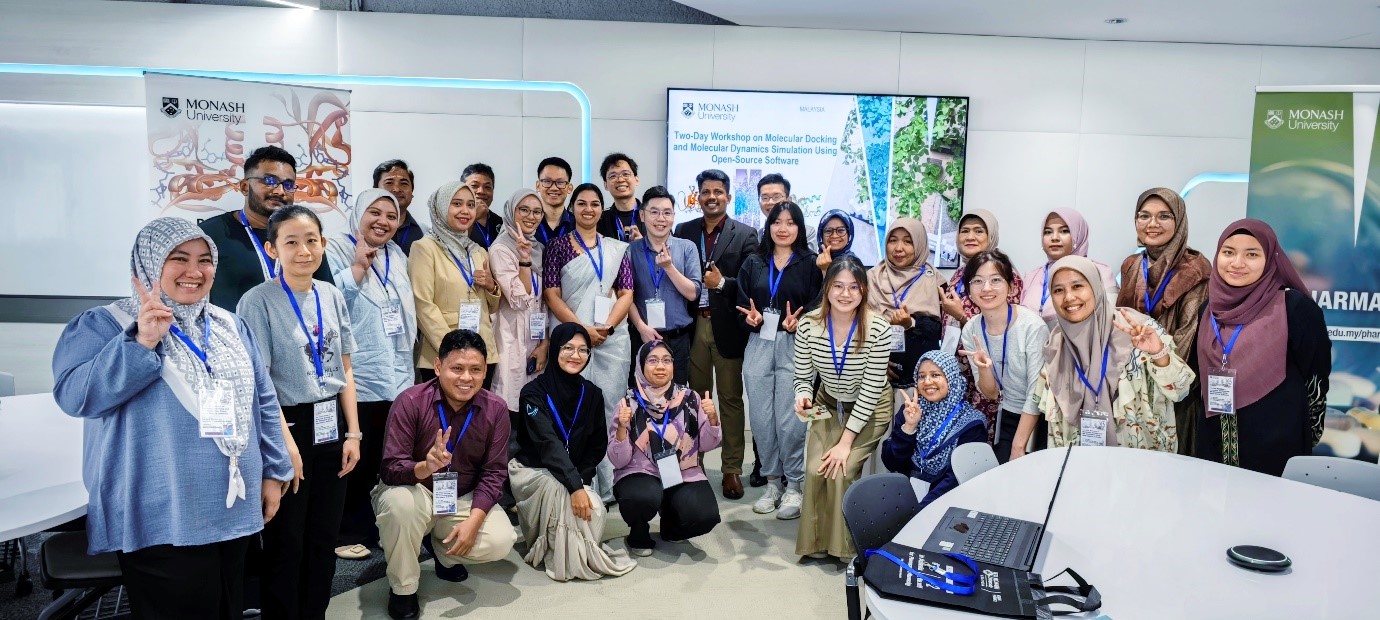
Two-Day Workshop on Molecular Docking and Molecular Dynamics Simulation Using Open-Source Software

The School of Pharmacy, Monash University Malaysia, proudly hosted the Two-Day Workshop on Molecular Docking and Molecular Dynamics Simulation Using Open-Source Software on 25–26 November 2024. The event was a significant step forward in advancing computational approaches in pharmaceutical research and drug discovery. It attracted over 30 participants, including researchers, academicians, and professionals from Malaysia, Indonesia, and Thailand, showcasing its regional impact and collaborative spirit.
The workshop provided an intensive exploration of molecular docking and molecular dynamics (MD) simulations, emphasizing the use of open-source tools AutoDock Vina and GROMACS. These computational techniques are essential for modern drug discovery, enabling detailed studies of protein-ligand interactions and biomolecular dynamics.
The first day of the workshop centered on molecular docking, with insightful sessions conducted by Dr. Prabitha Prabhakaran, a distinguished expert from the Department of Pharmaceutical Chemistry, JSS College of Pharmacy, JSS Academy of Higher Education and Research, Mysuru, India. Participants were introduced to the critical steps involved in preparing proteins and ligands for docking studies, followed by hands-on practice with AutoDock Vina to simulate and analyze ligand binding to target proteins. They also gained valuable skills in interpreting docking scores and poses to evaluate binding affinity and interaction stability. The interactive discussions and problem-solving sessions further enhanced participants' understanding of docking principles and techniques, making the day both engaging and educational.

The second day of the workshop shifted focus to molecular dynamics (MD) simulations, providing participants with a detailed exploration of the dynamic behavior of biomolecular systems. Sessions began with an introduction to the theoretical foundations of MD simulations, highlighting their importance in drug discovery and structural biology. Participants then delved into practical workflows using GROMACS, learning to set up simulation environments through processes such as solvation, energy minimization, and equilibration. They also gained expertise in trajectory analysis, including techniques for evaluating root-mean-square deviation (RMSD), hydrogen bonding, and molecular stability. The hands-on training sessions offered invaluable experience in running simulations and analyzing data, equipping participants with a comprehensive understanding of MD simulations and their applications.
The workshop sessions were led by Dr. Prabitha Prabhakaran and supported by a dedicated team of facilitators from Monash University Malaysia, including Assoc. Prof. Dr. Mahendran Sekar, Dr. Sathiya Maran, Dr. Khaw Kooi Yeong and research scholars Miss Amrita Muralikrishnan and Miss Amanda Kong Shen Yee. Their collaborative efforts ensured the smooth execution of the workshop, fostering an engaging and enriching learning environment for all participants.

The workshop attracted participants from diverse fields, including computational chemistry, bioinformatics, and structural biology. Researchers, academicians, and professionals from Malaysia, Indonesia, and Thailand actively engaged in interactive sessions, demonstrating a keen interest in learning and applying these advanced computational techniques. The multicultural and multidisciplinary participation added a rich dimension to the discussions, fostering cross-border collaboration and knowledge exchange.
By the end of the workshop, participants had successfully mastered the preparation and parameterization of protein and ligand structures for docking and molecular dynamics (MD) simulations. They conducted docking studies, analyzed binding energies, interpreted simulation results, and gained practical experience using AutoDock Vina and GROMACS for computational drug design. Participants also learned to integrate docking and MD simulations for a comprehensive approach to studying protein-ligand interactions and explored real-world applications and case studies in drug discovery. Feedback from attendees highlighted high satisfaction with the workshop's practical approach, expert guidance, and opportunities for networking with peers from neighboring countries, with many appreciating the relevance of the real-world case studies presented.
The School of Pharmacy, Monash University Malaysia extends its heartfelt gratitude to all participants, trainers, and facilitators for their enthusiastic involvement and to the organizing committee for their meticulous planning, ensuring the event's resounding success and a seamless learning experience for all.