
From water to cleaner transport: advancing diesel fleet decarbonisation with Trident Nova
From water to cleaner transport: advancing diesel fleet decarbonisation with Trident Nova
Diesel trucks are not disappearing anytime soon, but that does not mean their emissions cannot be significantly reduced during the transition toward a low-carbon transport sector.
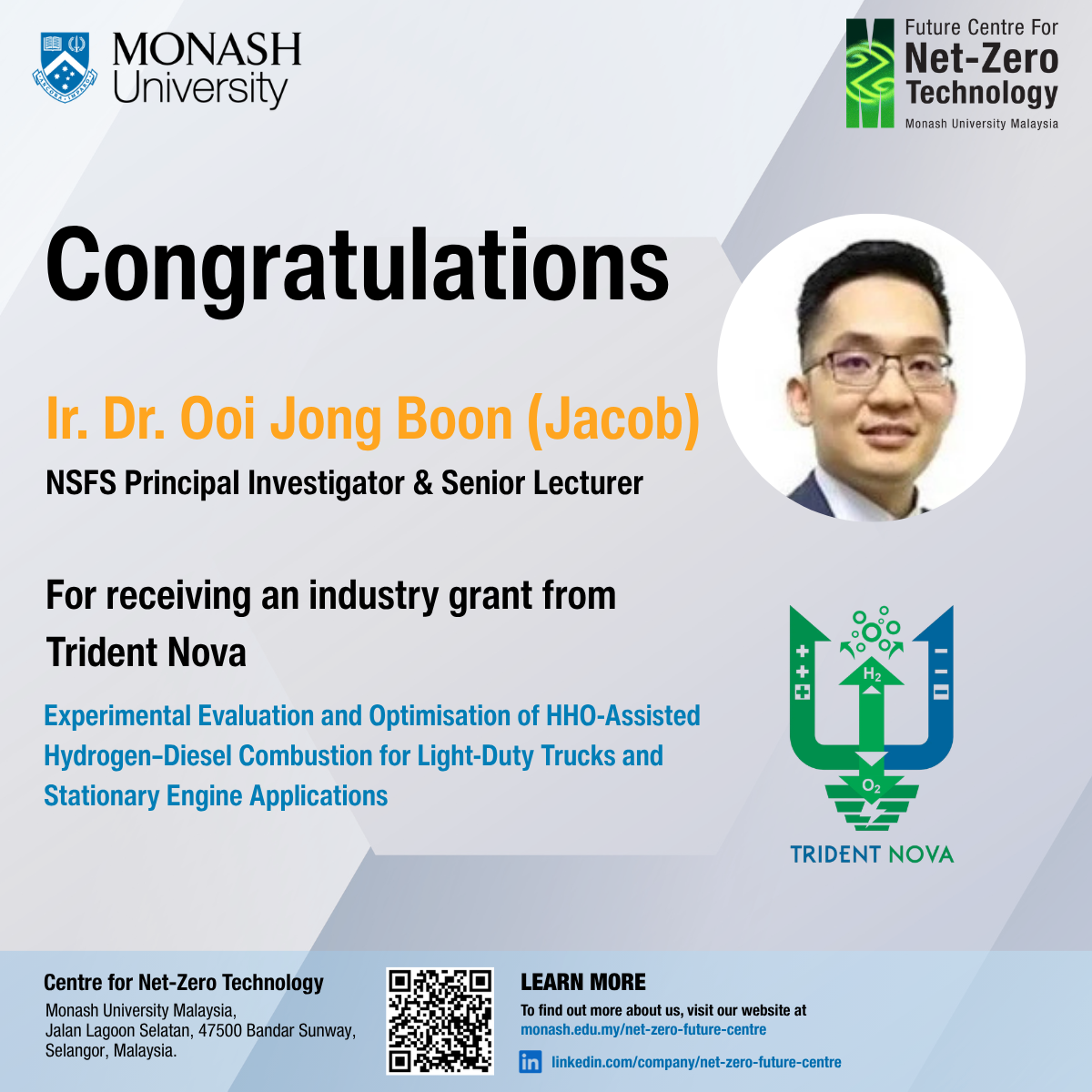
Ir. Dr. Jong Boon Ooi (Jacob) from Monash University Malaysia has secured an industry grant from Trident Nova Sdn. Bhd. for the project "Experimental Evaluation and Optimisation of HHO-Assisted Hydrogen-Diesel Combustion for Light-Duty Trucks and Stationary Engine Applications", aimed at developing a compact on-board hydrogen generation device capable of splitting water into hydrogen and oxygen gas for direct integration into a diesel engine's combustion cycle. Dr. Jacob is also the Principal Investigator of one of CNZT's Net-Zero Strategic Funding Scheme (NSFS) flagship projects, "Towards Zero-Emission Power Generation: Optimising an Integrated Hydrogen-Powered Genset System with PEM Electrolyser and Electric Turbo-Compounding". This collaborative project brings together Dr. Arulnageswaran Aruleswaran (Director, Trident Nova Sdn. Bhd.) and Mr. Agill Aynngran Raj (PhD student, School of Engineering, Monash University Malaysia).
This research addresses one of the most immediate decarbonisation challenges globally: the continued dependence on existing diesel-powered heavy vehicular fleets. While full electrification or hydrogen fuel-cell replacement of heavy-duty transport remains constrained by infrastructure, cost, and scalability challenges, hydrogen-assisted diesel combustion presents a pragmatic and near-term pathway to reduce emissions from current fleets without requiring complete engine replacement.
Early testing of the on-demand hydrogen production system has demonstrated meaningful reductions in carbon monoxide, unburned hydrocarbons, and smoke emissions through improved combustion efficiency. Building on these promising findings, the project will now focus on real-world operational validation, system optimisation, and performance assessment under practical driving conditions.
Importantly, this project represents a critical prerequisite first step toward the broader decarbonisation of diesel fleets. By enabling cleaner combustion within existing engine platforms, the technology can serve as a transitional solution that bridges today’s diesel-dependent transport systems with future hydrogen-powered mobility ecosystems. The outcomes of this work are expected to provide valuable technical insights and deployment pathways for reducing emissions across logistics, heavy transport, industrial generators, and off-grid applications where diesel engines are likely to remain operational for years to come.
CNZT congratulates Dr. Jacob and the research team on this achievement and looks forward to the successful implementation and future impact of this project in advancing practical net-zero transition technologies.
Contact: Ooi Jong Boon (Jacob)
Email: ooi.jongboon@monash.edu