
Net-Zero Speaker Series 4: Exploring the future of energy materials
Net-Zero Speaker Series 4: Exploring the future of energy materials
Note: This is a repost from the following article by Monash University Malaysia
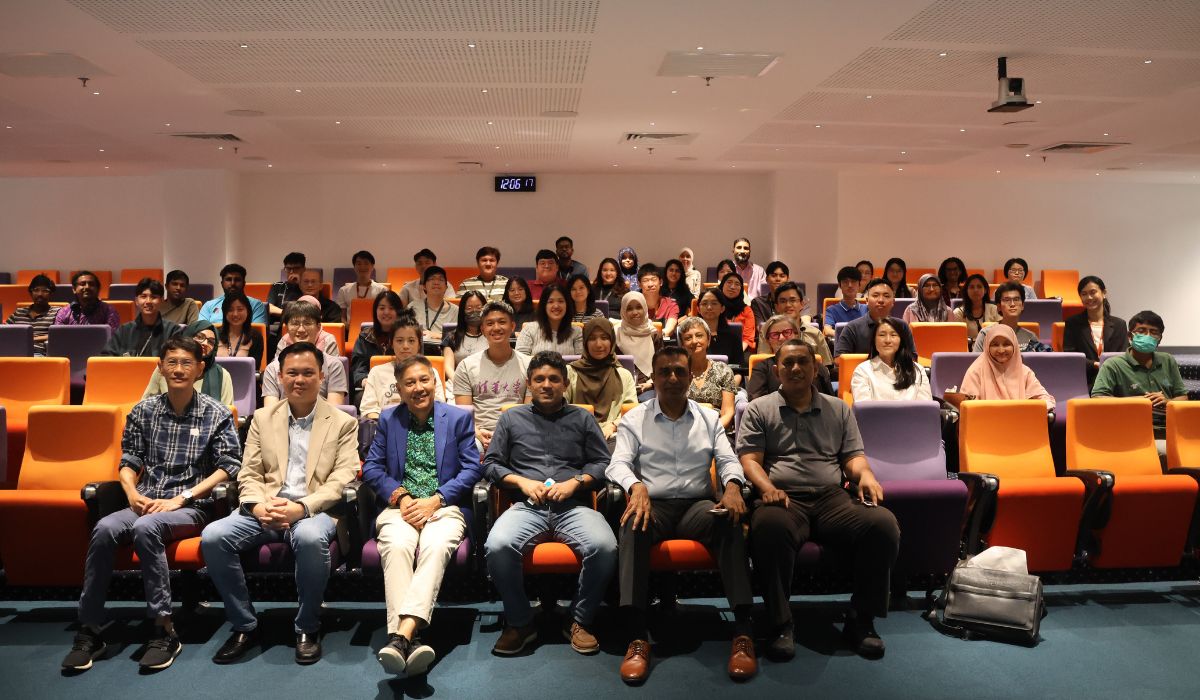 Group photo of the attendees with Professor Saiful Islam (front row, third from left) during the fourth Net-Zero Speaker Series
The university welcomed academics, industry partners, and students to the fourth instalment of the Net-Zero Speaker Series on 14 November 2025, featuring Professor Saiful Islam from the University of Oxford. Hosted by the Monash Future Centre for Net-Zero Technology (CNZT), the lecture examined how atomic-scale science is influencing the development of the next generation of clean-energy technologies.
Professor Islam, a materials chemist and dedicated science communicator, was introduced as a pioneer in the study of energy materials, spanning lithium-ion batteries, sodium-ion systems, solid-state electrolytes, and emerging solar cell technologies. He also holds a Guinness World Record for generating the highest voltage produced by a lemon battery.
Before beginning his talk, Professor Islam invited attendees to put on a pair of red–blue 3D glasses that had been distributed. Several of his slides were specially designed with 3D effects, allowing crystal structures to “pop out” of the screen. This playful visual approach helped the underlying science become more accessible to everyone.
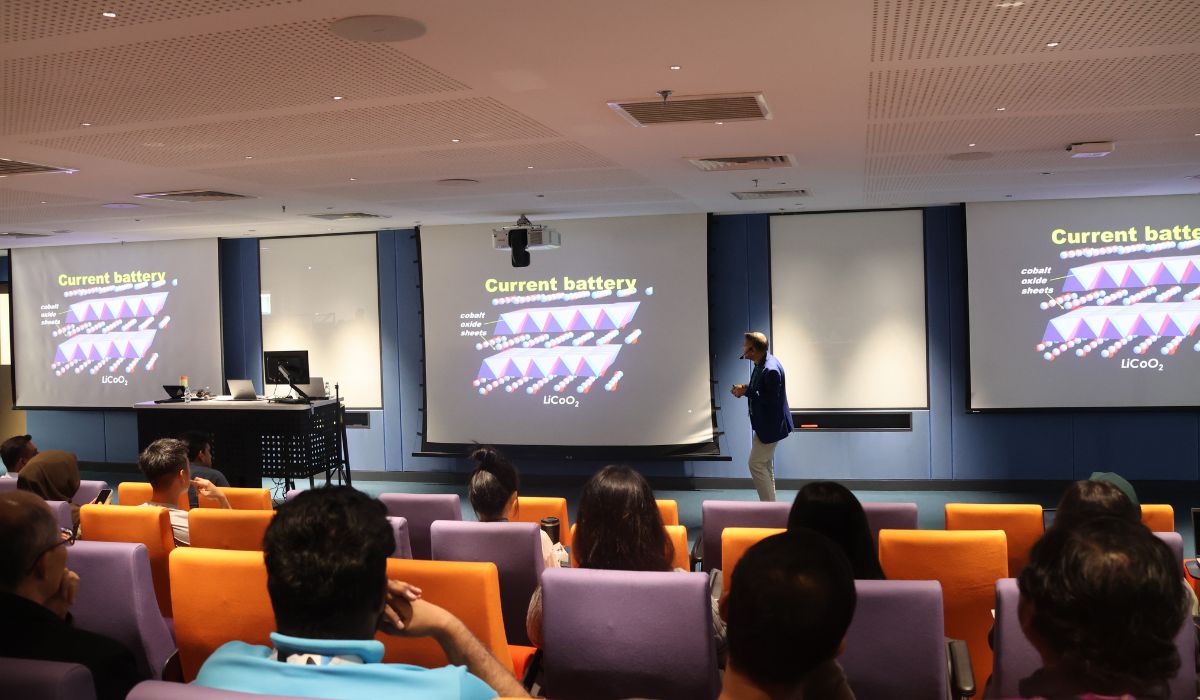 One of the presentation slides that had a 3D effect on them, in which attendees can put on the provided 3D glasses
His lecture, titled “From Batteries to Solar Cells – Exploring Energy Materials on the Atomic Scale”, opened with the global challenge of transitioning to low-carbon energy. Professor Islam highlighted how the materials used in batteries and solar cells are central to this shift. Using a combination of 3D graphics and animation, he demonstrated how ions move through layered structures in lithium-ion batteries and how computational methods can predict the movement of lithium and sodium ions long before experiments are completed.
He also addressed the sustainability concerns of current lithium-ion batteries, particularly the dependence on cobalt. While lithium-ion technology will remain dominant for smartphones and portable electronics due to its high energy density, he noted that sodium-ion batteries are quickly gaining traction for grid storage and small electric vehicles because sodium is cheaper, more abundant, and more environmentally friendly.
Shifting to solar-cell technology, Professor Islam explained the rapid rise of perovskite solar cells, which have seen unprecedented improvements in efficiency over the past decade. However, challenges remain in improving their long-term durability and addressing inherent structural defects. He shared recent research from Oxford showing how molecular passivation strategies can significantly improve stability and prevent charge recombination.
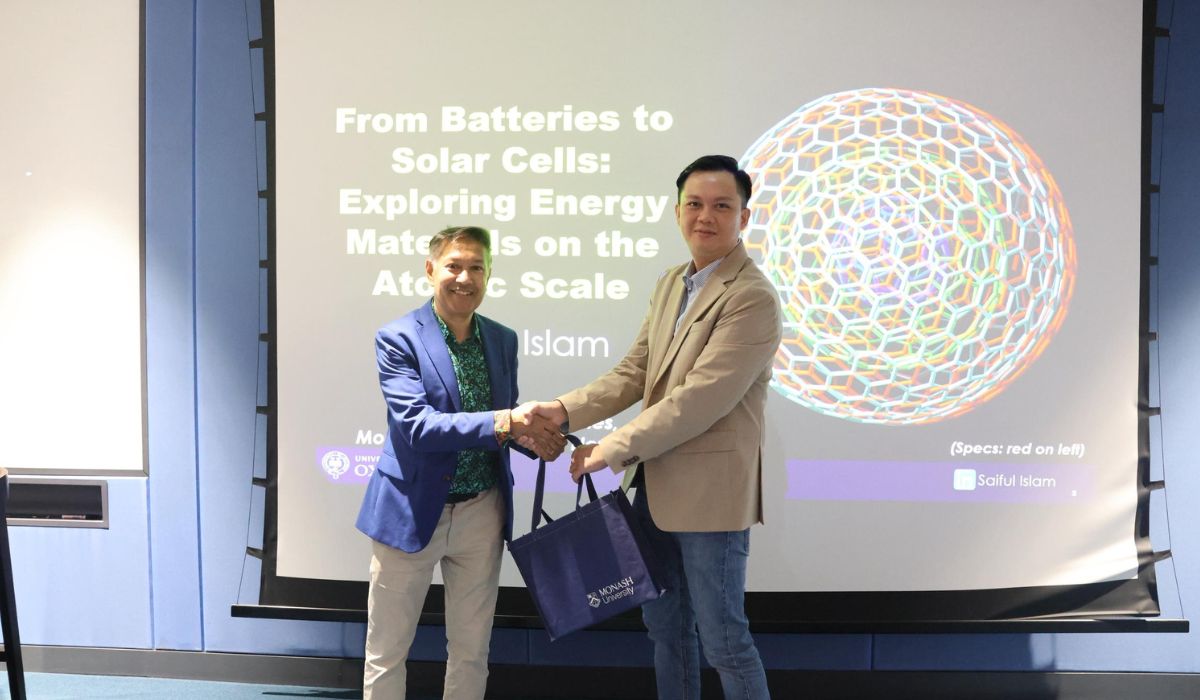 From left to right: Professor Saiful Islam receiving a token of appreciation from Professor Chong Meng Nan, Director of CNZT, after the conclusion of the talk
The talk concluded with a Q&A session, during which audience members asked about solid-state batteries, environmental concerns around lithium extraction, and how researchers might design materials that are easier to recycle. Professor Islam emphasised the importance of designing with end-of-life considerations in mind, mentioning opportunities for greater policy action and technological innovation in battery recycling. He also offered candid advice to young researchers in the crowd, encouraging them to follow their curiosity, work hard, and “collaborate with people who are smarter than you”, which he joked was his own secret to success.
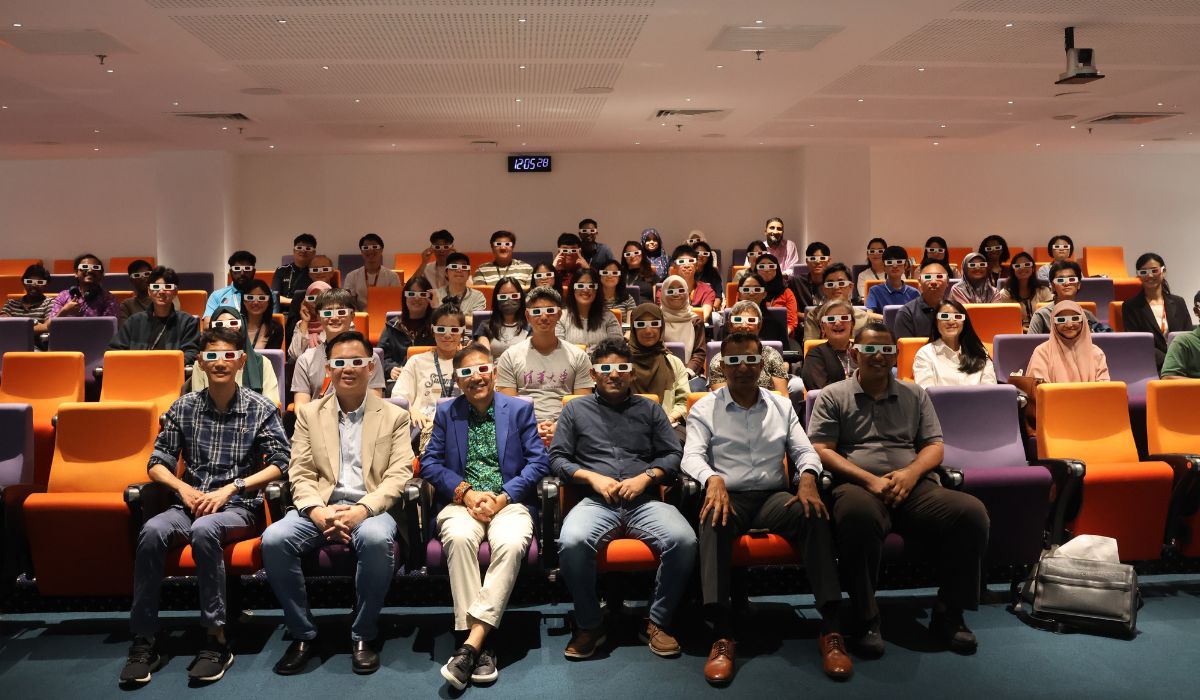 The speaker and the attendees of the event posing with the provided 3D glasses
The fourth Net-Zero Speaker Series showcased the university’s commitment to advancing research in sustainable energy and promoting meaningful exchanges with global experts. The presentation exhibited the critical role that materials science plays in creating a cleaner, greener future.
Contact: Dr. Sridhar Sri
Email: sridhar.sri@monash.edu