
A holistic approach to advancing and securing ASEAN’s net-zero future
A holistic approach to advancing and securing ASEAN’s net-zero future
Net-zero is no longer a mere concept confined to academic discourse. The growing realities and impacts of global climate change, increasingly experienced across the world and here in Malaysia, has necessitated the urgent need for a whole-of-society approach to accelerate the transition towards a net-zero carbon economy by 2050. However, achieving such an ambitious target cannot rely on any single solution; it requires a coordinated and multifaceted approach across technologies, sectors, policies, and society. Crucially, several key questions must be addressed: How can we develop advanced energy materials that enable more efficient clean energy technologies? How can biomass waste be transformed through circular approaches into valuable and sustainable products? And how can these innovations be integrated into renewable and smart energy systems that are reliable, affordable, and capable of creating tangible benefits to the communities they serve?
At Monash University Malaysia’s Centre for Net-Zero Technology (CNZT), we address these questions holistically, bringing together multiple perspectives and areas of expertise to develop integrated solutions for the net-zero transition. Established in 2024 under the leadership of Professor Ir. Dr. Chong Meng Nan, CNZT brings together expertise across three interconnected research themes of Advanced Energy Materials, Biotransformation, and Sustainable Urban Energy Solutions, to advance net-zero innovation and research excellence across ASEAN and beyond. While each theme addresses a distinct dimension of the net-zero challenge, their collective strengths enable a multidisciplinary and integrated approach to developing solutions, shaping conversations, and accelerating the transition towards a net-zero future.
Building the technologies of tomorrow
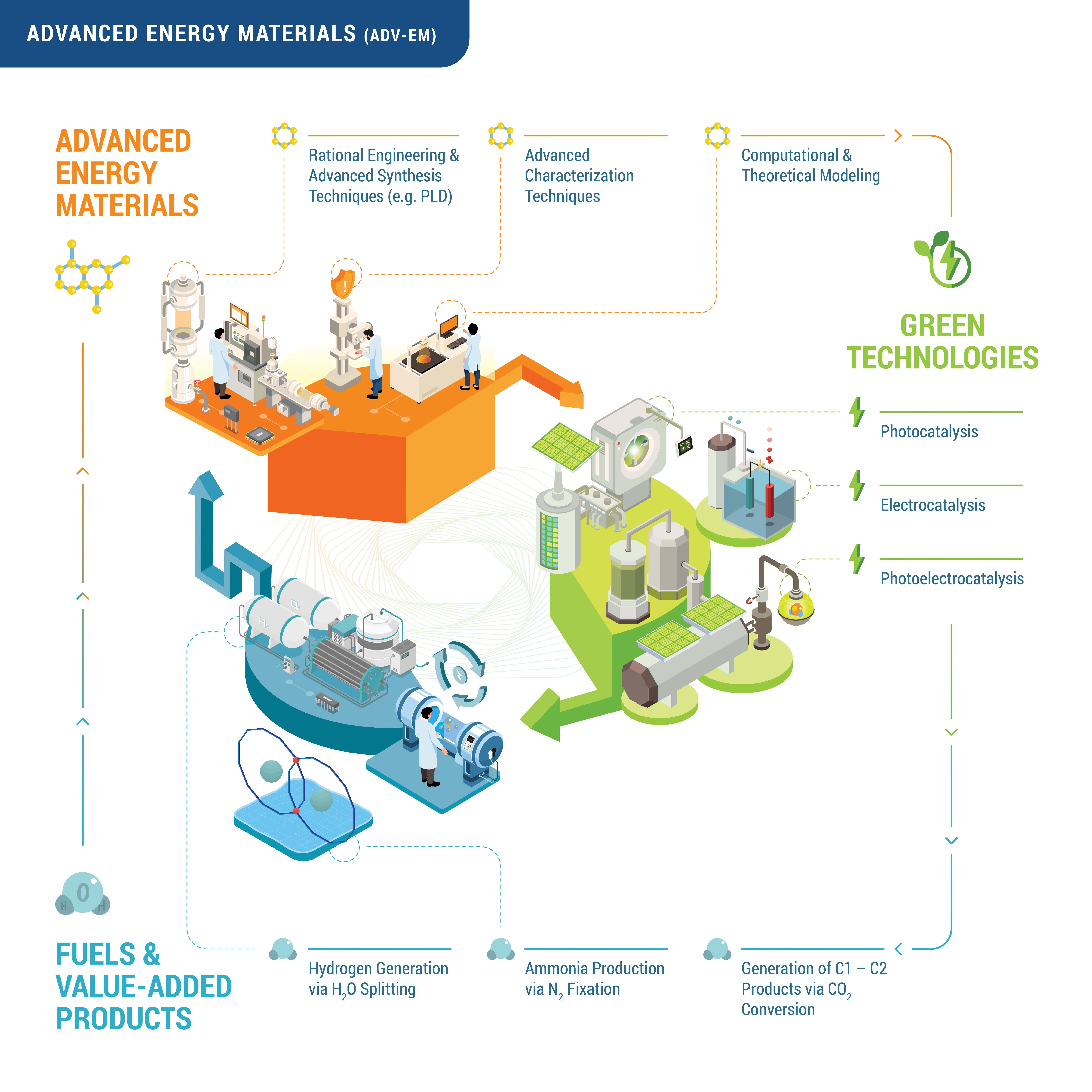
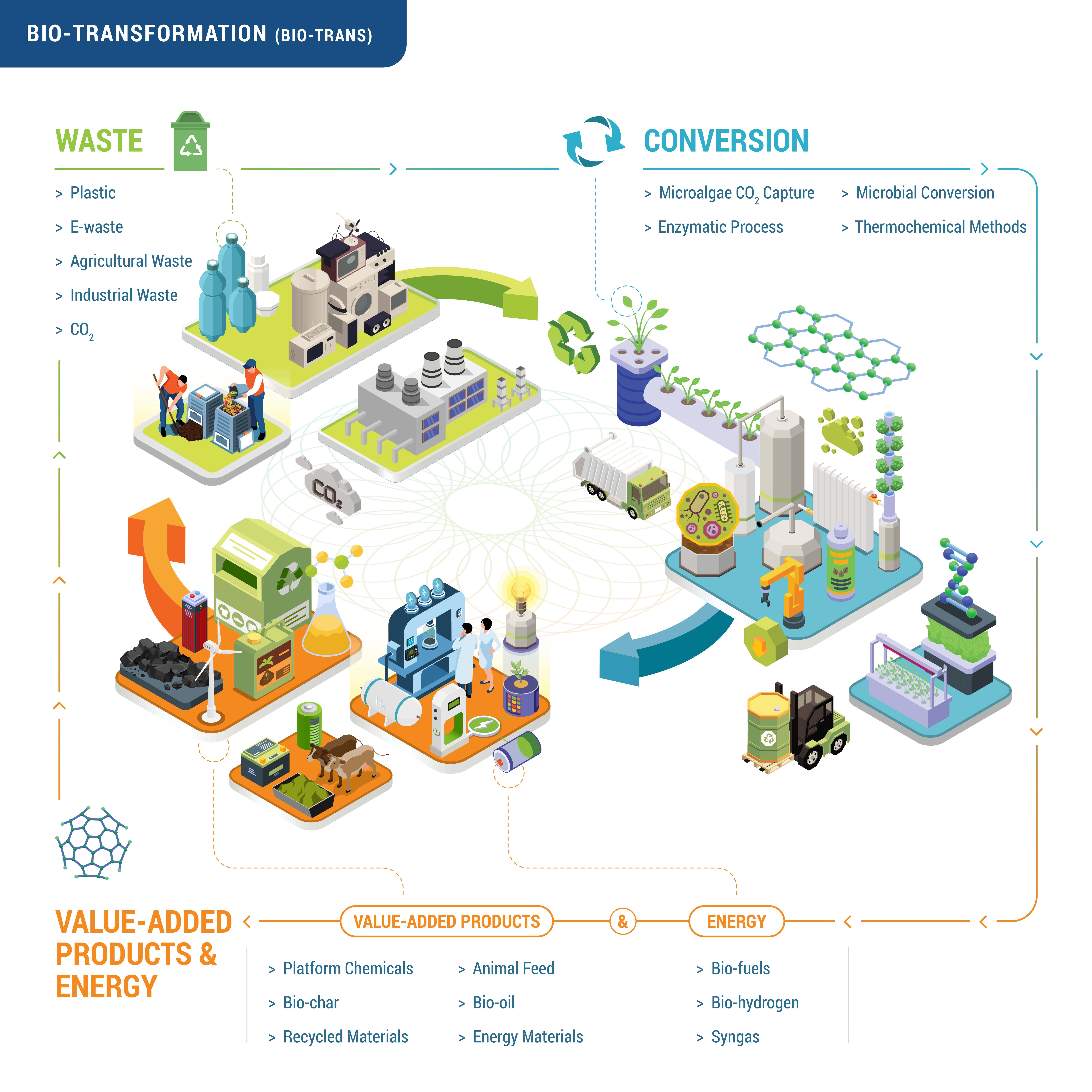
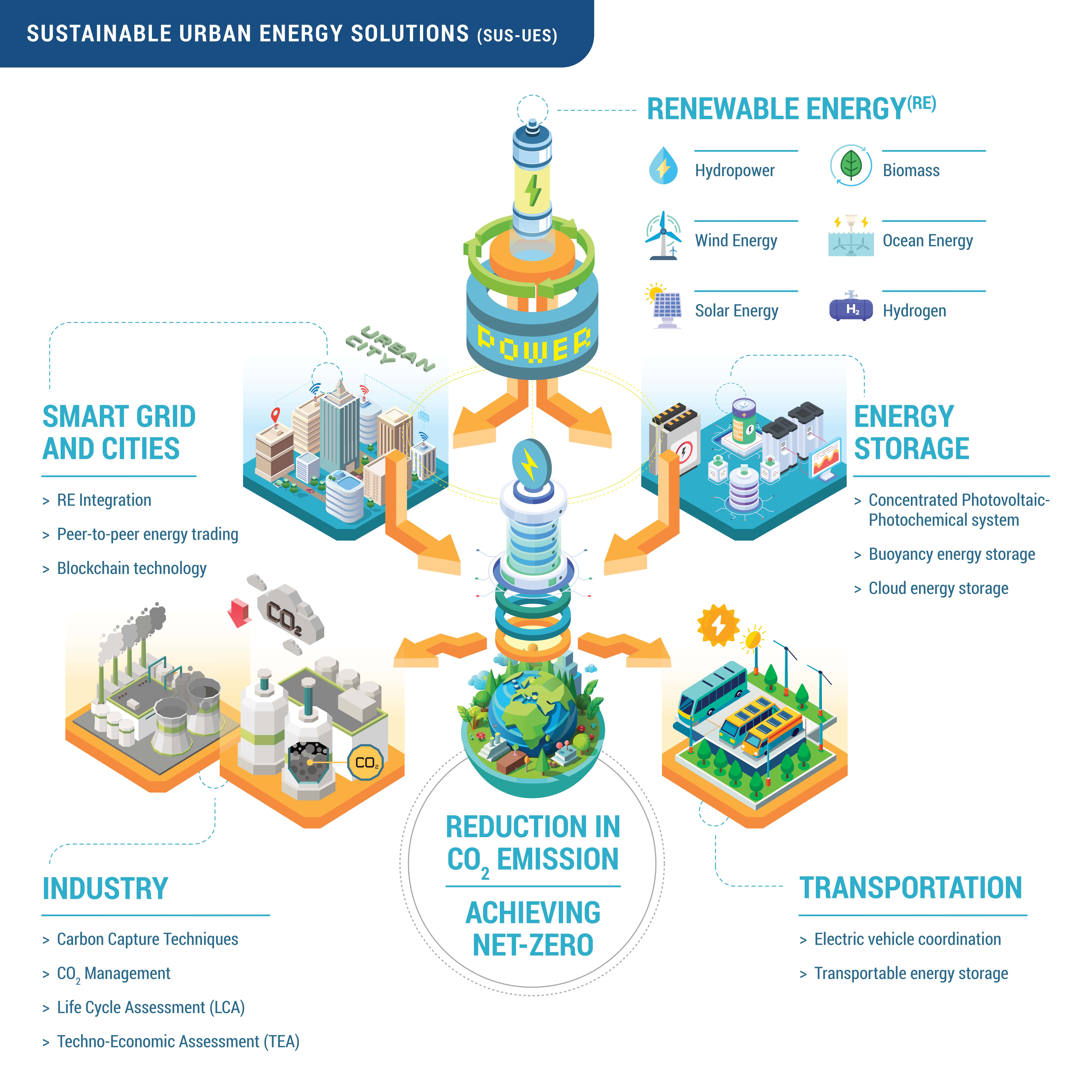
Illustration of the three key research themes of CNZT.
The first piece of the puzzle lies at the materials level, where the properties and performance of materials fundamentally shape the efficiency and viability of clean energy technologies. Under the Advanced Energy Materials theme, CNZT researchers, led by Associate Professor Ir. Dr. Tan Lling-Lling, are developing advanced materials and innovative processes to enable more efficient and sustainable energy conversion. One key area of focus is green hydrogen, which can be produced by using renewable electricity to split water into hydrogen and oxygen through a process known as water electrolysis. While the principle is relatively straightforward, translating it into an efficient, durable, and economically viable technology presents significant challenges. Central to overcoming these challenges is the development of high-performance catalysts that can accelerate the necessary chemical reactions while maintaining their activity and stability under demanding operating conditions.
Beyond green hydrogen, our researchers are also exploring a broader range of clean and sustainable energy carriers, including the conversion of captured CO₂ into value-added carbon-based fuels and chemicals, as well as the development of more sustainable pathways for ammonia production. A ground-breaking study led by Mr Justin Khor has discovered that aliovalent Sn2+ substitution into layered Cs3Bi2Br9 photocatalyst can yield a 3.4-fold increase in solar-driven CO2,conversion to methane, as published in Advanced Energy Materials. Increasingly, experimental research at CNZT is being integrated with robotics and artificial intelligence to accelerate materials discovery and development. By enabling high-throughput, automated chemical synthesis alongside data-driven prediction of material properties and performance, these technologies allow researchers to explore and optimise promising materials with greater speed and precision.
Bio-transforming waste into sustainable resources
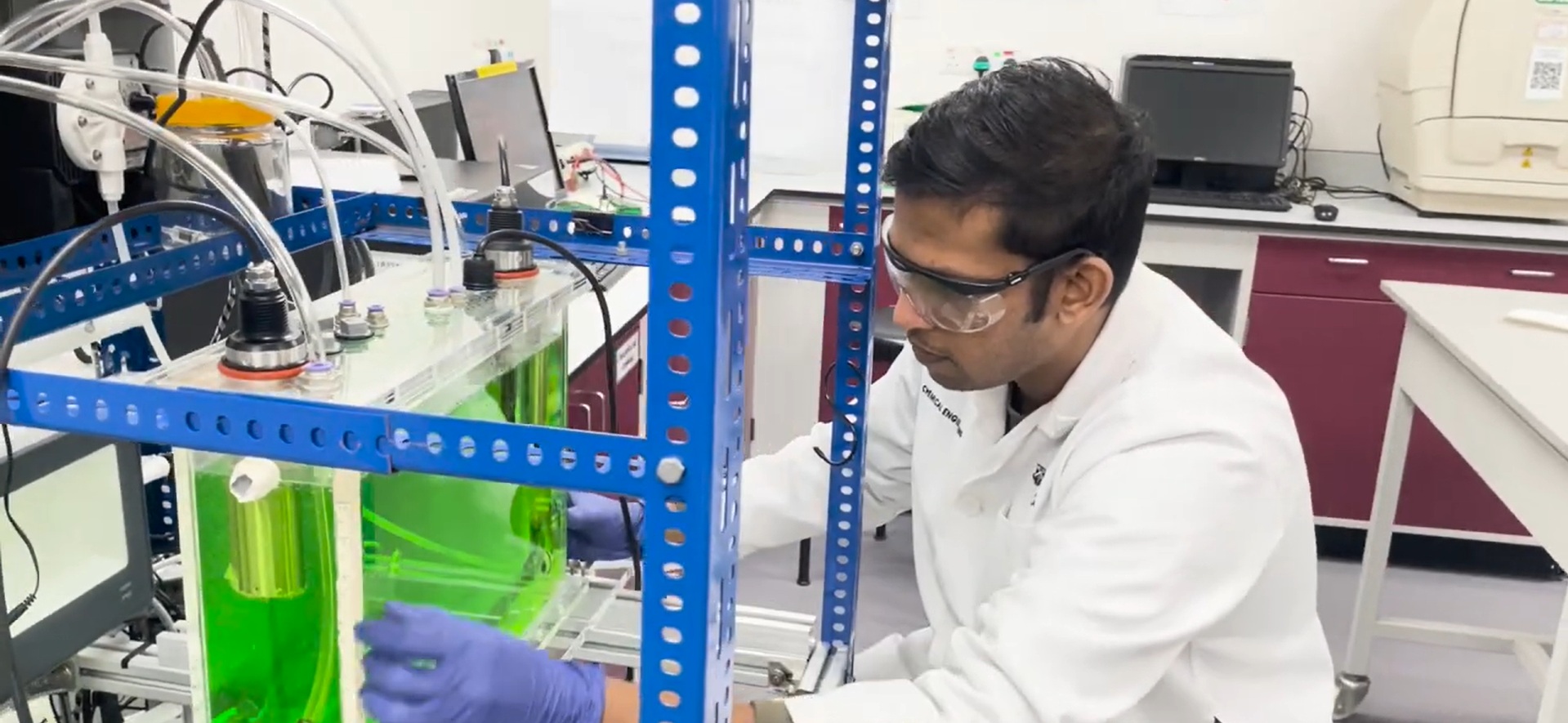
Manuja Dayanath (PhD student and one of the members of the Universities for Goal 13 winning team) at work on the photobioreactor.
The net-zero challenge, however, extends beyond how we generate and use energy. A sustainable future also requires us to rethink how existing agricultural biomass and waste streams can be transformed via circular approaches from underutilised resources into valuable and sustainable products. This is particularly relevant to Malaysia and the wider ASEAN region, where agriculture contributes more than 8% and 10% of gross domestic product, respectively, while generating substantial quantities of biomass residues and waste.
This challenge lies at the heart of CNZT’s Biotransformation theme, led by Prof. Wu Ta Yeong. The theme explores how biological processes can be harnessed to transform biomass and other resources into high-value products, creating new pathways for resource circularity while supporting more sustainable and low-carbon modes of production.
Nature itself offers remarkable examples of efficient chemical transformation. Microorganisms and algae can convert molecules into useful compounds under relatively mild conditions. By understanding and engineering these processes, researchers can explore new approaches for converting waste and biomass, while utilising carbon dioxide to produce valuable chemicals and energy carriers. A student-led team supervised by Associate Professor Saman Ilankoon has devised a lab-scale flat-panel photobioreactor that uses microalgae to tackle the dual challenge of reducing carbon emissions from industrial flue gas while producing valuable nutraceutical products. This invention won the 4th edition of the global “Universities for Goal 13” competition, organised by the United Nations and Siemens Energy, which received a commendation by Prof. Jeffrey Sachs, President of the UN Sustainable Development Solutions Network (SDSN).
The significance of biotransformation lies in its potential to move society towards a more circular and sustainable model of resource use. Rather than treating carbon-rich biomass and organic waste as materials to be discarded, these resources can be transformed into valuable feedstocks for producing useful materials, chemicals and energy. In doing so, biotransformation not only reduces waste and environmental burden but also unlocks new value from existing resources, reduces reliance on fossil-based feedstocks, and creates opportunities for new low-carbon industries and circular value chains.
Connecting net-zero technology to the places where we live

CNZT’s Dr Tan Wen Shan (2nd from left) with the eCOS project team members at the SEDA Innovation Challenge.
Yet, even the most advanced materials or biological processes cannot deliver a net-zero future on their own. Their true impact can only be realised when these technologies are effectively integrated into the complex energy systems that power our cities, industries and communities. Bridging the gap between technological innovation and real-world implementation therefore lies at the heart of CNZT’s third theme, Sustainable Urban Energy Solutions, led by Dr Tan Wen Shan.
Cities are major consumers of energy and are therefore central to the energy transition. As renewable energy becomes more widely deployed, energy systems must become more flexible and intelligent to deal with the vagaries of intermittent renewable sources (i.e., solar) while energy demand changes throughout the day. For Malaysia and Southeast Asia, this challenge is particularly important as the combination of rapid development with growing energy demand, coupled with its inherent tropical climates and diverse urban and rural communities mean that solutions need to be bespoke and adapted to local conditions.
CNZT's work in this area comprises designing innovative solutions which includes thinking about energy systems not simply as collections of individual technologies, but as interconnected networks that must be efficient, resilient and responsive to changing needs. Notably, Dr Tan Wen Shan collaborated with AmSolar Sdn. Bhd. to develop an innovative digital control system (eCOS) that integrates solar photovoltaics and battery energy storage which successfully reduced energy cost for consumers by up to 20%, which clinched the 2024 Sustainable Energy Development Authority (SEDA) Innovation Challenge award.
From research to real-world impact
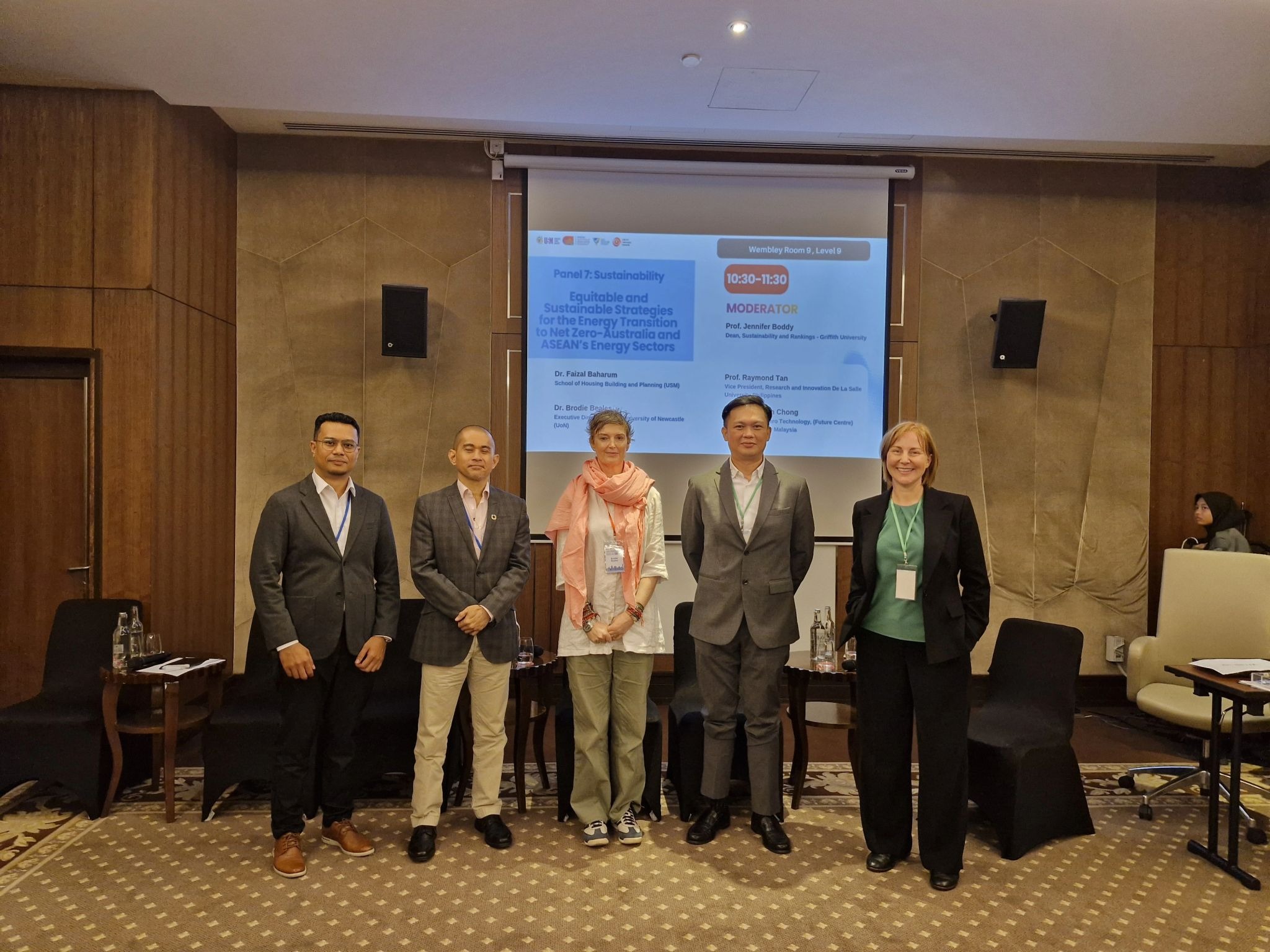
Prof. Ir. Dr. Chong Meng Nan (2nd from right) participating in the ASEAN-Australia Education Dialogue 2025.
Achieving the net-zero transition also requires collaboration well beyond the boundaries of the university. CNZT operates within a broader innovation ecosystem that brings together researchers, government agencies, industry partners and international collaborators. These partnerships are critical for translating research into real-world impact and helping researchers understand industry needs, validate technologies under realistic operating conditions, overcome barriers to scale-up, and create viable pathways towards commercial deployment.
One example is CNZT’s collaboration with PETRONAS Research Sdn. Bhd., led by Prof. Ir. Dr. Chong Meng Nan, to advance a commercially scalable, solar-driven capillary-fed proton exchange membrane (PEM) electrolyser for green hydrogen production. By bridging fundamental research with industry-led development and scale-up, the collaboration demonstrates how university–industry partnerships can accelerate promising clean-energy technologies from the laboratory towards practical application.
CNZT’s impact extends well beyond the research laboratory. Our researchers are actively contributing to the wider net-zero conversation by providing thought leadership across leading publications and national and international forums, helping to bridge scientific evidence with policy, industry and societal needs. More recently,a group of CNZT members led by Dr. Yaw Chong Siang contributed a thought-leadership article to the Institution of Engineers Malaysia (IEM) Jurutera Bulletin, examining the role of carbon capture, utilisation and storage (CCUS) as a key pathway for decarbonising Malaysia’s hard-to-abate sectors. Similarly, Professor Chong highlighted the importance of an equitable and multidisciplinary approach to advancing the net-zero transition through research and education at the ASEAN-Australia Education Dialogue 2025.
Through these contributions, CNZT aims to go beyond developing technological solutions to provide leadership in shaping the net-zero agenda. By advancing new ideas, informing policy and industry conversations, and championing evidence-based and inclusive approaches, CNZT seeks to help shape the direction of the net-zero transition in Malaysia and across ASEAN.
Contact: Chong Meng Nan
Email: chong.meng.nan@monash.edu