Colloquium Article
Ottawa at Forty: Why Health Promotion Has to Get Serious About Power
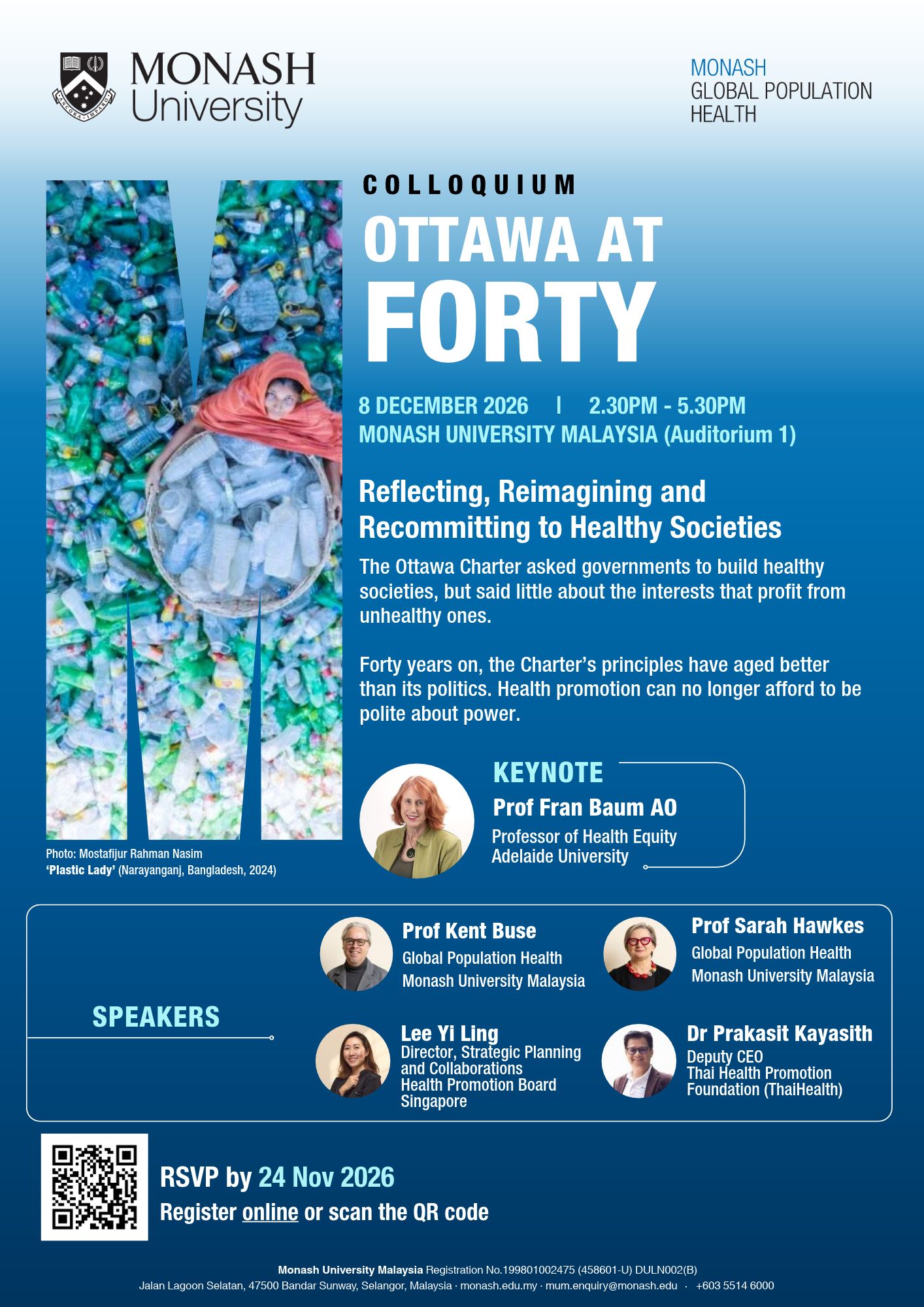
Join us at Monash University Malaysia on Tuesday 8 December 2026 as we mark forty years of the Ottawa Charter by reflecting, reimagining and recommitting to healthy societies.
The Ottawa Charter asked governments to build healthy societies, then said very little about the interests that profit from unhealthy ones. Forty years on, its principles have aged better than its politics, and health promotion can no longer afford to be polite about power.
On Tuesday 8 December 2026, the Department of Global Population Health at Monash University Malaysia is convening policymakers, researchers, and regional leaders in health systems for a half-day colloquium that asks: what would it take to build societies that produce health rather than treat its absence? RSVP here by 24 November.
Why Ottawa needs a more political reading now
The 1986 Charter held that health is created where people live, learn, work and play, but it assumed that evidence and good intentions would change the conditions that shape it, and never said how or by whom. The decades in which Ottawa should have been implemented were instead the decades in which the state retreated and prevention was left with a fraction of health spending.
The next decades will be fought on different terrain. With the United States out of the World Health Organization and the aid it underwrote cut, the multilateral consensus on which Ottawa's successors relied is gone, evidence itself is contested by industry-funded doubt and machine-generated misinformation, and Southeast Asia is one of the places where the new rules will be written.
In Malaysia the contests are already under way, from tobacco and vape law to prevention spending. The Generational End Game showed what organised commercial interests can do to a law with majority support, and non-communicable diseases cost an estimated RM64 billion a year while the state still subsidises sugar.
What happens on the day
The colloquium is built around solutions rather than diagnosis: what has worked, where and for whom, judged predominantly by what it does for the people left furthest behind.
Professor Fran Baum AO opens with the keynote. As Professor of Health Equity at Adelaide University, a former Commissioner on the WHO Commission on Social Determinants of Health and a past co-chair of the People's Health Movement, she is one of the leading scholars of the social, political and commercial determinants of health.
Globally relevant lessons and what would work in Malaysia will then be discussed by regional health leaders, including Ms Lee Yi Ling, Director, Strategic Planning & Collaborations at Singapore’s Health Promotion Board; and Dr Prakasit Kayasith, Deputy CEO of ThaiHealth.
Who should be in the room
Researchers, policymakers, civil society leaders and students from Malaysia and the region are welcome. If your work touches tobacco and vape regulation, prevention financing, drug policy or any other fight over the conditions that shape health, this is an afternoon to spend with us.
The colloquium also marks the start of a sustained programme of interdisciplinary work at Monash University Malaysia on the social, political and commercial determinants of health. Those who attend will be present at the beginning of something designed to last, and colleagues interested in collaborating are invited to get in touch.
- When: Tuesday, 8 December 2026, 2.30pm to 5.30pm
- Where: Auditorium 1, Monash University Malaysia, Bandar Sunway
- Hosted by: Department of Global Population Health, Jeffrey Cheah School of Medicine and Health Sciences