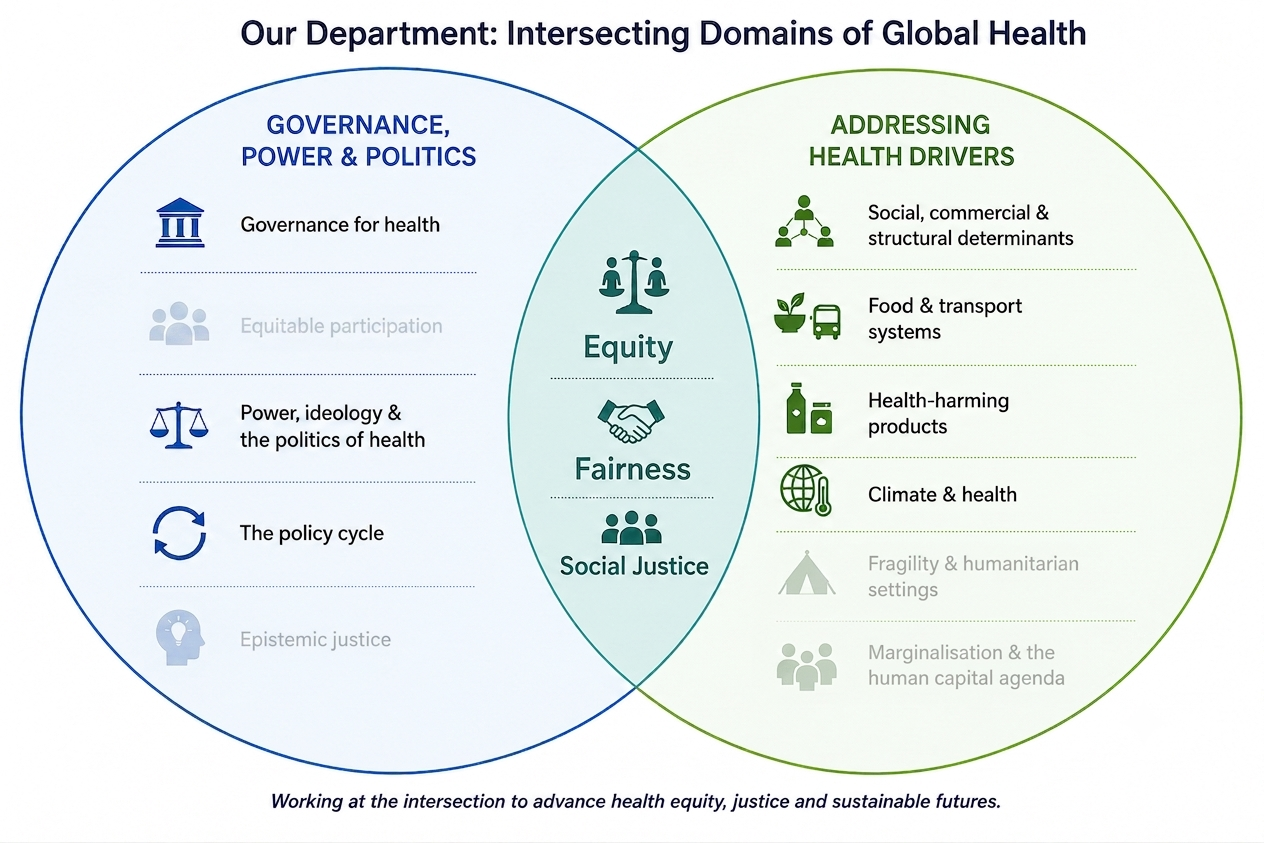
The framework and how we use it
We work from a practical framework for analysing the ideas, interests and institutions that shape any health issue — the approach set out in Making Health Policy and used to train students, researchers and practitioners worldwide. Alongside it sits a body of methods work on how to do political analysis rigorously and ethically, including prospective policy analysis and tools for the institutional, political and social analysis of reform. This is how we equip the next generation to think — and act — politically.
Key outputs:
- Buse K, Mays N, Walt G. Making Health Policy, 3rd edition (Open University Press).
- Buse K. Addressing the theoretical, ethical and practical challenges inherent in prospective health policy analysis. Health Policy and Planning, 2008;23(5):351–360.
- Buse K. Tools for institutional, political and social analysis of policy reform. Development, 2008.
- Glassman A, Buse K. Politics and public health policy reform. In International Encyclopedia of Public Health, 2nd ed., 2017.
Across the issues
The distinctive claim is that the same political lens travels. Our work applies it, among other things, across the following:
Non-communicable diseases and the commercial determinants of health.
Obesity prevention, ultra-processed foods, physical activity policy, and the corporate power that shapes them.
Selected outputs:
- Buse K, Mialon M, Jones A. Thinking politically about UN political declarations: a recipe for healthier commitments — free of commercial interests. International Journal of Health Policy and Management, 2021.
- Milton K, Buse K, Bull F. Powerful actors who undermine physical activity policy must be challenged. BMJ, 2025;388:r487.
- Carriedo A, et al. (Buse K, senior author). Ultra-processed foods: challenging corporate power and promoting local food systems to reclaim health. Globalization and Health, 2026;22:49.
- Buse K. Time to think (and act) more politically about nutrition. Global Nutrition Report, 2016.
HIV and the governance of the AIDS response.
From the politics of scaling up evidence-informed policies to the leadership of the global response.
Selected outputs:
- Buse K, Altman D (eds). Thinking Politically about HIV (Routledge, 2014).
- Altman D, Buse K. Thinking politically about HIV: political analysis and action in response to AIDS. Contemporary Politics, 2012;18(2):127–140.
- Sidibé M, Tanaka S, Buse K. People, passion and politics: looking back and moving forward in the governance of the AIDS response. Global Health Governance, 2010.
- Buse K, Lalji N, Mohamad I, Mayhew SH, Hawkes S. Political feasibility of scaling-up five evidence-informed HIV policies. Sexually Transmitted Infections, 2009;85(Suppl 2):ii37–ii42.
Gender and global health.
The politics of gender in global health institutions and agendas.
Selected outputs:
- Hawkes S, Buse K. The politics of gender and global health. In Oxford Handbook of Global Health Politics (OUP, 2019).
- Evagora-Campbell, M., Kedia, S., Odero, H. O., Uppal, R., Odunga, S. A., Mattoo, T., . . . Buse, K. (2024). Legislation for advancing women's leadership in the health sector in India and Kenya: a 'law cube' approach to identify ways to strengthen legal environments for gender equality. BMJ GLOBAL HEALTH, 9(7), 13 pages. doi:10.1136/bmjgh-2023-014746
- Hawkes, S., Buse K. (2020). Socially constructed determinants of health: The case for synergies to arrive at gendered global health law. Public Health Ethics, 13(1), 16-28. doi:10.1093/phe/phaa013
Global governance for health.
How power is organised across the institutions, partnerships and rules that govern global health — from the rise of public–private partnerships and emerging powers to the soft law and reform of bodies such as WHO.
Selected outputs:
- Buse K, Hein W, Drager N (eds). Making Sense of Global Health Governance: A Policy Perspective. Palgrave Macmillan, 2009.
- Buse K, Walt G. Global public–private health partnerships: Part II — what are the issues for global governance? Bulletin of the World Health Organization, 2000;78(5):699–709.
- Taylor A, Alfvén T, Hougendobler D, Tanaka S, Buse K. Leveraging nonbinding instruments for global health governance: reflections from the Global AIDS Reporting Mechanism for WHO reform. Public Health, 2014;128(2):151–160.
- McBride B, Hawkes S, Buse K. Soft power and global health: the SDG-era health agendas of the G7, G20 and BRICS. BMC Public Health, 2019;19:815.
Evidence, equity and data.
Why disaggregated data, health equity and the defence of evidence are political rather than merely technical questions.
Selected outputs:
- Buse K, McKee M, Pagel C. Safeguarding evidence for health in the face of political pressure. BMJ, 2026;393:s628.
- Buse K, Nambiar D. Health equity: we need political action, not performative promises. BMJ, 2023;383:p2735.
- Buse K, Gautam A, Hussain U, Olarewaju V. The dearth of disaggregated health data: a political rather than a technical challenge. BMJ, 2023;381:p1254.
Planetary health, comprehensive public health and health security.
The power and privilege behind intersectoral action and pandemic preparedness.
Selected outputs:
- Buse K, et al. Tackling the politics of intersectoral action for the health of people and planet. BMJ, 2022;376:e068124.
- Gepp S, Otieno MA, Buse K. Planetary health: challenging power and privilege is key to a fairer and healthier future. BMJ, 2024;385:q853.
- Buse K, McKee M. UK political parties pledge to strengthen security — yet ignore health security. BMJ, 2024;385:q1359.