The themes and how we work
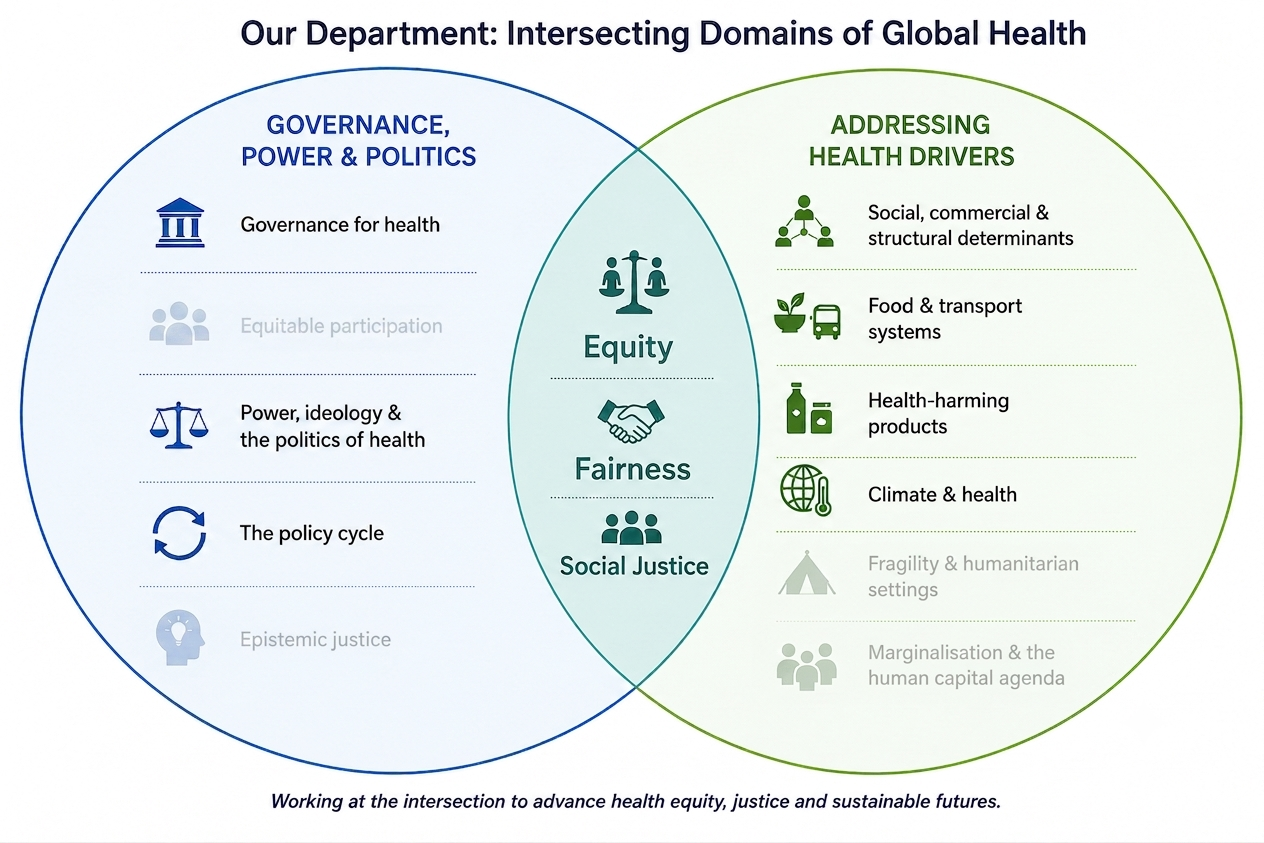
Our work is organised around five connected themes, each illustrated by — not summed up by — a selection of published work.
Understanding and measuring the drivers. We collaborate with others to develop the concepts and frameworks that make commercial power visible and measurable: how health-harming industries operate, where power concentrates, and how it shapes the conditions for health long before anyone reaches a clinic.
Key outputs:
- Freudenberg N, Lee K, Buse K, et al. Defining priorities for action and research on the commercial determinants of health: a conceptual review. American Journal of Public Health, 2021;111(12):2202–2211. doi:10.2105/AJPH.2021.306491
- Lee K, et al. (incl. Buse K). Measuring the commercial determinants of health and disease: a proposed framework. International Journal of Health Services, 2021. doi:10.1177/00207314211044992
- Buse K, Tanaka S, Hawkes S. Healthy people and healthy profits? Elaborating a conceptual framework for governing the commercial determinants of non-communicable diseases. Globalization and Health, 2017;13:34. doi:10.1186/s12992-017-0255-3
Health-harming products: tobacco, food and beyond. We trace how specific industries and their products, marketing and political practices produce ill health and widen inequities — from the political economy of tobacco to the corporate shaping of children's food environments.
Key outputs:
- Bandara S, et al. The political economy of tobacco in Zimbabwe: an analysis of stakeholder perspectives. PLOS Global Public Health, 2025;5(6):e0004805. doi:10.1371/journal.pgph.0004805
- Sircar NR, Bialous SA. Tobacco industry's human rights makeover: an archival review of British American Tobacco's human rights rhetorical veneer. Tobacco Control (2024). DOI: 10.1136/tobaccocontrol-2022-057337
- Fisher L, Dahal M, Hawkes S, Puri M, Buse K. Barriers and opportunities to restricting marketing of unhealthy foods and beverages to children in Nepal: a policy analysis. BMC Public Health, 2021;21:1351.
- Neiloy Sircar & Stanton Glantz, Defeating Juul’s Effort to Rewrite San Francisco’s E-Cigarette Regulations, American Journal of Public Health (2021). DOI: 10.2105/AJPH.2020.305993
Partnerships, conflicts of interest and the rules of engagement. We examine when, whether and how public actors should work with industry — the design and limits of public–private partnerships, and the safeguards needed to manage conflicts of interest.
Key outputs:
- Buse K, Walt G. Global public–private partnerships: Part I — a new development in health?; Part II — what are the issues for global governance? Bulletin of the World Health Organization, 2000;78(4):549–561; 78(5):699–709.
- Patay D, et al. (Buse K, senior author). Fifty shades of partnerships: a governance typology for public–private engagement in the nutrition sector. Globalization and Health, 2023;19:11. doi:10.1186/s12992-023-00912-1
- Buse K, Hawkes S. Sitting on the FENSA when engaging with Big Industry. The Lancet, 2016;388(10043):446–447.
Regulation, taxation and the law. We study the levers that constrain commercial harm — fiscal measures, legal and treaty tools such as the WHO Framework Convention on Tobacco Control, and the limits of rights-based and regulatory approaches.
Key outputs:
- Marten R, et al. including Buse K Sugar, tobacco, and alcohol taxes (STAX): indispensable tools to achieve the Sustainable Development Goals. The Lancet, 2018. doi:10.1016/S0140-6736(18)31219-4
- Jones A, Wu HYJ, Buse K. The United Kingdom's sugar tax hits the regulatory sweet spot. BMJ, 2021;372:n463. doi:10.1136/bmj.n463
- Neiloy Sircar & Stella Bialous, Assessing the links between human rights and global tobacco control through statements made on global fora, BMC Public Health (2021). DOI: 10.1186/s12889-021-10451-2
Contesting the corporate narrative. Commercial actors do not only shape products and policies — they shape the story: how a problem is defined, who is blamed, and which solutions seem realistic. We expose this "corporate pollution" of health discourse and build counter-narratives.
Key outputs:
- Van Schalkwyk M, Petticrew M, Hawkins B, Buse K. Reclaiming the narrative: countering the corporate pollution of health discourse. Health Promotion International, 2024;39(6):daae182. doi:10.1093/heapro/daae182
- Maani N, van Schalkwyk M, Petticrew M, Buse K. The pollution of health discourse and the need for effective counter-framing. BMJ, 2022;377:o1128. doi:10.1136/bmj.o1128
- Sircar N, Fleming ME, Bialous SA. Does a human rights-based approach to harm reduction support commercialized harm reduction? Frontiers in Public Health, 2022;10:1001036. https://research.monash.edu/en/publications/does-a-human-rights-based-approach-to-harm-reduction-support-comm; doi:10.3389/fpubh.2022.1001036