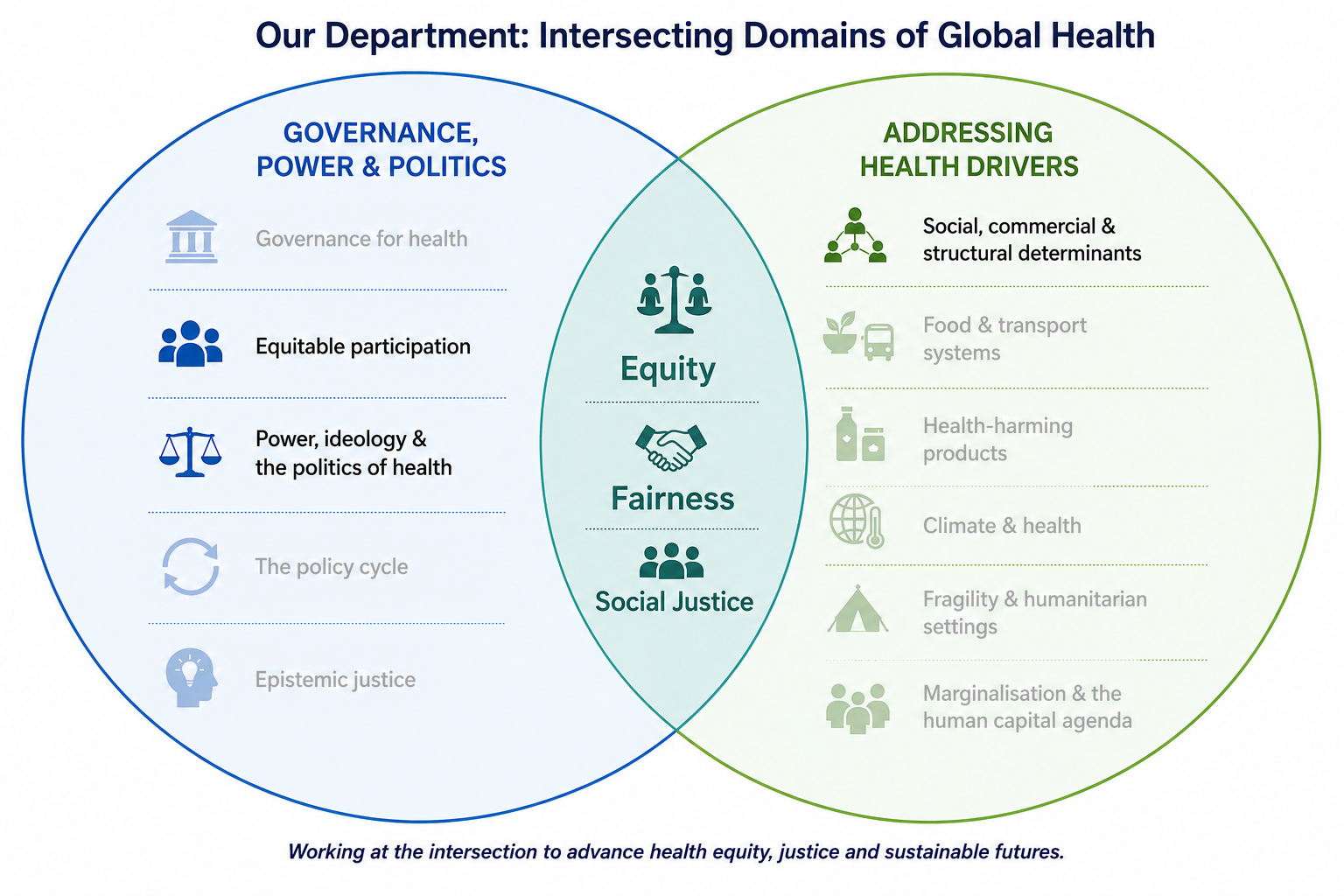
Our research is organised around five connected themes, each anchored in a substantial body of published work.
The politics of gender and health.
We analyse how gender is contested, ignored or instrumentalised within global health institutions, agendas and financing - from the Sustainable Development Goals to global public–private partnerships- and what it takes to move gender from rhetoric to action.
Key outputs:
- Hawkes, S., Buse, K., Clark, J. P., Connell, R., Cislaghi, B., Darmstadt, G. L., . . . Sy, E. A. (2026). When the rules are rewritten, strengthen the coalition for gender justice. LANCET, 407(10532), 929-931.
- Hawkes S, Buse K. The politics of gender and global health. In The Oxford Handbook of Global Health Politics (OUP, 2020). doi:10.1093/oxfordhb/9780190456818.001.0001 ·
- Manandhar M, Hawkes S, Buse K, et al. Gender, health and the 2030 agenda for sustainable development. Bull WHO, 2018;96(9):644–653. doi:10.2471/BLT.18.211607
Gender as a determinant of health outcomes.
We examine how the gender order, gender roles and gender relations drive who is exposed to risk, who benefits from health care, and who succumbs to illness or death, building the evidence base on the gendered health pathways experienced by all people across the lifecourse. Our work includes a distinct and growing body of work on men’s health and the social construction of masculinities.
Key outputs:
- Hawkes S, Sy EA, Barker G, et al. Achieving gender justice for global health equity: the Lancet Commission on gender and global health. The Lancet, 2025;405(10487):1373–1438. doi:10.1016/S0140-6736(25)00488-X ·
- Hawkes, S., Connell, R., Clark, J., Klugman, J., Darmstadt, G. L., Nelson, E., . . . Buse, K. (2025). Gender and global health: going, going, but not gone. LANCET, 405(10487), 1317-1320. doi:10.1016/S0140-6736(25)00617-8
- Gamlin JB, Hawkes SJ. Masculinities on the continuum of structural violence: Mexico’s homicide epidemic. Social Politics, 2017. doi:10.1093/sp/jxx010
- Hawkes, S. (2024). Fixing systems not fathers. LANCET, 404(10459), 1187-1188.
Gender and equitable leadership in health.
We study why women, particularly women from low- and middle-income countries remain under-represented in health leadership despite dominating the workforce. and what legal, institutional and accountability levers can change that — making the case for feminist leadership and fairer research and career cultures.
Key outputs:
- Hawkes S, Baru R. Dismantling the structures of inequality: why we need feminist leadership in the health sector. BMJ, 2024;386:e078927. doi:10.1136/bmj-2023-078927 ·
- Buse K, Liwanag HJ, Koay A, et al (incl. Hawkes S). Strengthening systems of accountability for women’s leadership in the health sector. BMJ, 2024;386:e078960. doi:10.1136/bmj-2023-078960
- Clark, J., & Hawkes, S. (2024). Overcoming gender gaps in health leadership Trust in women's leadership is declining when it is most needed for health. BMJ-BRITISH MEDICAL JOURNAL, 387, 2 pages. doi:10.1136/bmj.q2768
The importance of sex-disaggregated measurement.
We show, repeatedly and with data, that what is not counted cannot be fixed: from COVID-19 to hypertension, diabetes and HIV, we track the gaps in sex-disaggregated data and the consequences of ignoring them.
Key outputs:
- Feraldi A, Zarulli V, Buse K, Hawkes S, Chang AY. Sex-disaggregated data along the gendered health pathways. PLoS Medicine, 2025;22(5). doi:10.1371/journal.pmed.1004592 ·
- Chang AY, Johnson EK, Bolongaita S, Buse K, Hawkes SJ, et al. From sex differences to sex inequalities in life expectancy. PLoS Medicine, 2025;22(12). doi:10.1371/journal.pmed.1004828 ·
- Hawkes S, Haseen F, Aounallah-Skhiri H. Measurement and meaning: reporting sex in health research. The Lancet, 2019;393(10171):497–499. doi:10.1016/S0140-6736(19)30283-1
How gender interacts with other systems of power.
We analyse how gender combines with commercial and legal power — from the commercial co-opting of feminist health narratives to the corporate drivers of non-communicable diseases and the legal environments that constrain equality — to produce health and its inequalities.
Key outputs:
- Hawkes, S. (2024). Commercial co-opting of feminist health narratives. BMJ-BRITISH MEDICAL JOURNAL, 384, 2 pages. doi:10.1136/bmj.q314
- Hawkes S, Kedia S, Odunga S, Dahal M. From flowers to menstrual-flow trackers: the corporatisation of women’s equality and wellbeing. The Lancet, 2023. doi:10.1016/S0140-6736(23)00456-7 ·
- Evagora-Campbell, M., Kedia, S., Odero, H. O., Uppal, R., Odunga, S. A., Mattoo, T., . . . Buse, K. (2024). Legislation for advancing women's leadership in the health sector in India and Kenya: a 'law cube' approach to identify ways to strengthen legal environments for gender equality. BMJ GLOBAL HEALTH, 9(7), 13 pages. doi:10.1136/bmjgh-2023-014746
- Hawkes, S., Buse K. (2020). Socially constructed determinants of health: The case for synergies to arrive at gendered global health law. Public Health Ethics, 13(1), 16-28. doi:10.1093/phe/phaa013
- Neiloy Sircar, Good Public Health Policy, Better Public Health Law: Blood Donation, Individual Risk Assessments, & Lifting the Deferral for Men Who Have Sex With Men, Food and Drug Law Journal (2018). https://www.fdli.org/wp-content/uploads/2018/02/Marchant-final.pdf