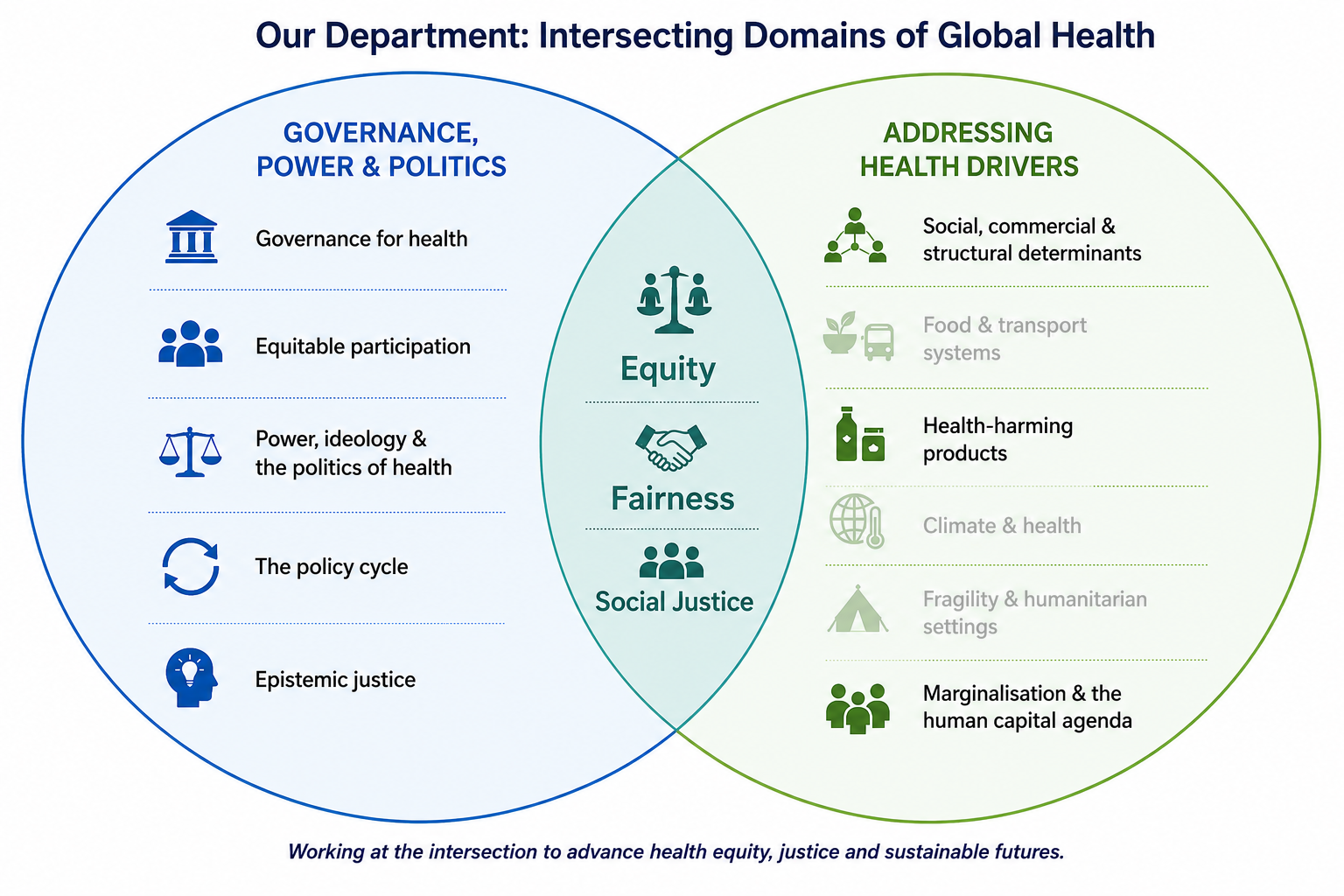
Legal determinants influence every stage of the policy cycle—from agenda setting and legislative design to implementation, accountability, and evaluation. Understanding how law interacts with politics, institutions, commercial interests, and social determinants is essential to explaining why some evidence-informed policies succeed while others stall, weaken, or fail.
Summary
Law is one of the most powerful structural determinants of health. Constitutions, legislation, regulation, judicial decisions, and international legal instruments shape governments' authority to act, the policies they adopt, and the accountability mechanisms that determine whether commitments translate into improved health outcomes.
This research programme examines how legal frameworks shape health policy across local, national, regional, and global contexts. We study how law enables, constrains, and institutionalises public health action, and how legal systems can better advance equitable, effective, and accountable health governance.
Our work spans domestic public health law, international legal instruments, trade and investment agreements, and rights-based frameworks to understand how legal systems shape governments' capacity to promote health and reduce inequities.
We examine the legal frameworks that shape public health action across local, national, regional, and global contexts. This includes domestic legislation and regulation, international agreements, treaty implementation (including the WHO Pandemic Agreement and the WHO Framework Convention on Tobacco Control), international trade law (including the WTO TRIPS Agreement), regulatory design, and the legal obligations that underpin effective public health systems.
Key outputs:
Neiloy R. Sircar et al. Human Rights Limitations for the new Global Health Law Reforms, Public Health (2026). DOI: 10.1016/j.puhe.2025.106081
Neiloy Sircar, Amit Yadav, & Stella Bialous, Assessing sector representation of non-state actors within the World Health Organisation Framework Convention on Tobacco Control, Global Public Health Journal (2021). DOI: 10.1080/17441692.2020.1823451
Neiloy Sircar & Stella Bialous, Assessing the links between human rights and global tobacco control through statements made on global fora, BMC Public Health (2021). DOI:10.1186/s12889-021-10451-2
Lawrence O. Gostin, Neil R. Sircar, & Eric A. Friedman, Fighting Novel Diseases Amidst Humanitarian Crises, Hastings Center Report (January-February, 2019). DOI: 10.1002/hast.970
Neiloy Sircar & Eric Friedman, Financial Security and Public Health: How Basic Income & Cash Transfers Can Promote Health, Global Public Health Journal (2018). DOI: 10.1080/17441692.2018.1460383
2. Equity, Rights, and Accountability
We examine how legal frameworks can promote, or undermine, equity, participation, and accountability in health. This includes research on rights-based approaches, legal accountability mechanisms, community participation, transparency, and the role of law in advancing equitable health outcomes.
Key outputs:
Neiloy Sircar & Allan Maleche, Perspectives on HIV Self-Testing Among Key and Affected Populations in Kenya, Journal of African Health Sciences (2022). DOI: 10.4314/ahs.v22i2.5
Sircar N, Fleming ME, Bialous SA. Does a human rights-based approach to harm reduction support commercialized harm reduction? Frontiers in Public Health, 2022;10:1001036. DOI:10.3389/fpubh.2022.1001036
Navita Kalair, Clio Korn, Larissa J Maier, Thomas Pospiech, Neiloy Sircar, Trisha Vaidyanathan, Medical Necessity Standards for Mental Health Parity in California, Journal of Science Policy and Governance (2020). DOI: 10.38126/JSPG170208
Neiloy Sircar & Allan Maleche, Assessing a Human Rights-Based Approach to HIV Testing and Partner Notification in Kenya: A Qualitative Study to Examine How Kenya’s Policies and Practices Implement a Rights-Based Approach to Health, Health and Human Rights (2020). https://pmc.ncbi.nlm.nih.gov/articles/PMC7762902/
Like the rest of the Department, we seek to generate research that informs policy and practice. Our work supports governments, international organisations, civil society, and communities in designing stronger institutions, implementing effective policies, and developing governance systems that promote health equity. We contribute to policy dialogue, technical assistance, implementation partnerships, and capacity strengthening throughout Malaysia, Southeast Asia, and beyond.
Ongoing Research Projects
Implementation in Global Health Governance. Examining the legal, institutional, and political factors that facilitate, or impede, the translation of international agreements and normative commitments into national policy and practice.
Trade, Intellectual Property, and Health. Examining how international trade and intellectual property regimes shape governments' policy space to advance public health and equitable access to medicines.
Health Policy Space. Developing a conceptual framework describing how formal legal authority, political feasibility, implementation capacity, and operational realities interact to shape governments' ability to enact evidence-informed public health policy.
Food Policy, Law, and Regulation in Southeast Asia. Investigating the legal, commercial, and institutional determinants influencing the development and implementation of healthy food policy across Southeast Asia.
Tobacco and Nicotine Control. Examining the legal and regulatory dimensions of tobacco and nicotine control, including implementation, commercial determinants, emerging nicotine products, and endgame strategies.
Malaysia and Southeast Asia provide a dynamic setting for studying health policy and governance. Countries across the region are addressing common challenges, including population ageing, non-communicable diseases, climate change, pandemic preparedness, commercial determinants of health, and health system reform, while navigating diverse political systems, legal traditions, and governance structures. The Department seeks to generate evidence that is regionally grounded, globally relevant, and responsive to the priorities of governments and the communities they serve.