
Tasia Khoo
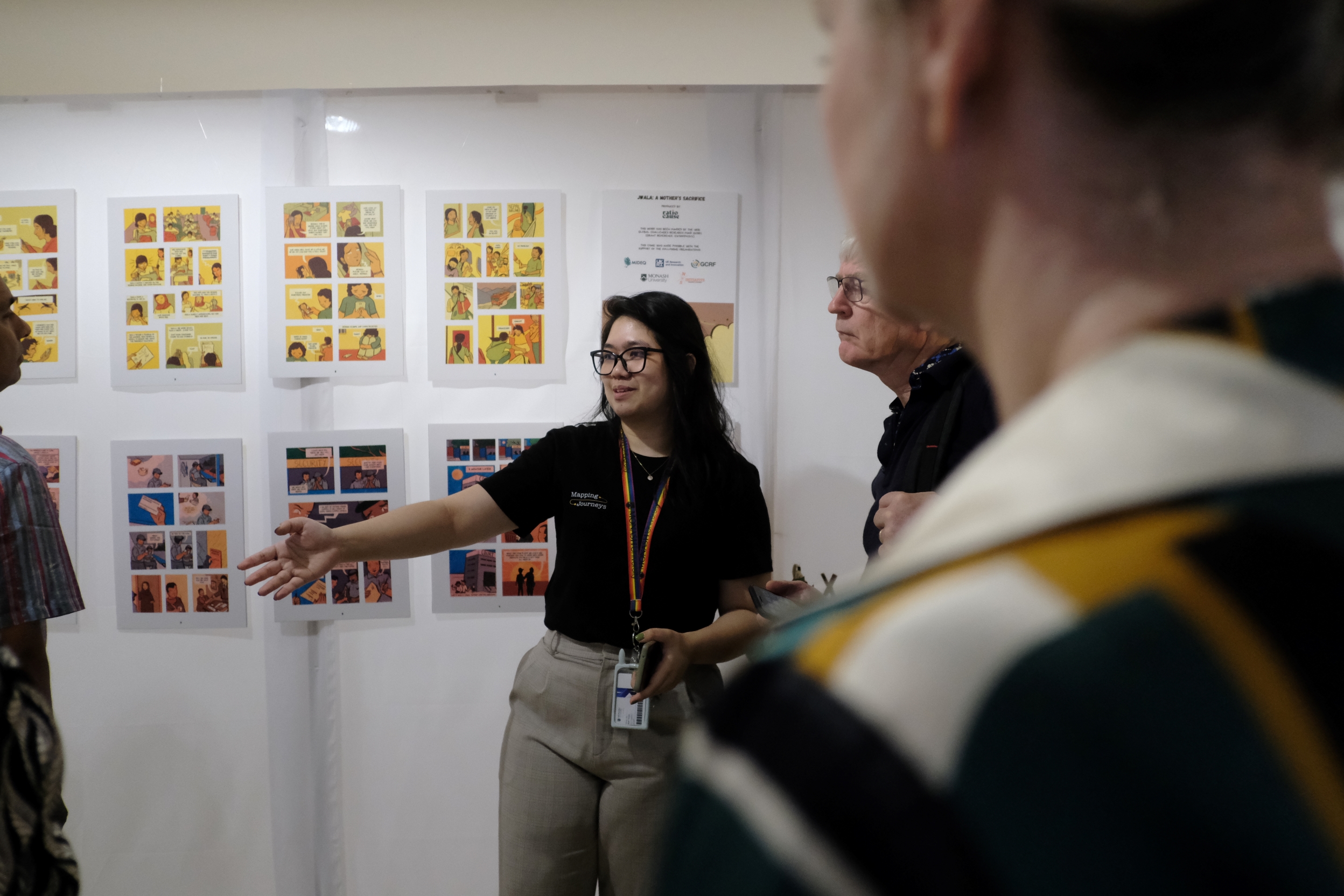
I was lucky and incredibly privileged to be given the opportunity to explore my curiosities at SASS, so much so I have decided to continue deepening these curiosities as a postgraduate.
Tasia Khoo describes herself as someone who was “not quite academically inclined” during her school years, and for a long time, she believed that three years of undergraduate study would be enough. That perspective shifted when she arrived at Monash University Malaysia. Through the people she met, the friends she made, and the classes she sat in, she began to see “how much bigger and vaster the world is; that there is always more to do and more to learn.” More importantly, she discovered how inspiring learning can be “when taught by the right people,” which ultimately led her to pursue a PhD.
Tasia was first introduced to the complexities of memory as a concept during her postmodern and postcolonial literature classes. Sitting in lectures and tutorials “wide-eyed,” she realised that something she once assumed to be simple was, in fact, deeply layered. She became intrigued by how memories, real or imagined, collective or personal, carry weight in shaping histories, identities, and relationships. Alongside literature, her studies in film, media, gender, and global studies broadened her worldview and introduced her to key theories and concepts that challenged her thinking and biases, encouraging her to critically examine the world around her and beyond.
The decision to continue into postgraduate study did not arrive in a single, defining moment. Instead, it was “the cumulation of many other moments, opportunities and experiences.” These included working closely with friends on assessments, helping one another develop ideas for major essays, and collaborating on video projects for group work. Enrolling in the Workplace Learning Internship Unit and interning at an art gallery, where she continues to contribute her work further shaped her path. During her Honours year, Tasia also served as a pastoral for the Global Immersion Guarantee (GIG) programme and worked as a secretariat for the Malaysia node of the Migration for Development and Equality Hub (MIDEQ). Across these experiences, she listened to people’s stories, their memories, and witnessed moments of growth, which inspired her through “diverse learning spaces and teaching approaches.” With that, she knew she would always return to education and academia.
Tasia’s current research sits within cultural studies and explores the concept of nostalgia, particularly how it connects people with the world around them, and how it informs the ways society understands the past, navigates the present, and imagines futures. She is  interested in how memory and nostalgia operate not only as sentimental or affective responses, but also as socio-cultural forces that shape identities and a sense of belonging.
Reflecting on her academic journey, Tasia shares that her undergraduate experiences helped develop reflexivity and intellectual curiosity, while fostering the ability to think critically, write analytically, and engage with multiple perspectives. As a PhD candidate, she continues to build adaptability, flexibility, and critical reflection, alongside problem-solving and creativity.
Like many researchers, Tasia has faced challenges, navigating critique, grappling with self-doubt, coping with burnout, and confronting the harsh realities of the world and the lived experiences of the individuals and communities she engages with. She finds support in conversations with peers and supervisors who understand the struggles of research and the PhD journey. These experiences, she reflects, remind her to approach both research and life with empathy, resilience, and humility.
While she says she is “still learning the important lessons,” Tasia has come to understand that knowledge, learning, and teaching are not individual pursuits. Instead, they are enriched through the people, perspectives, and experiences we engage with every day.
To current students considering further study, her advice is simple and grounded:
“Life is hard and it’s okay to take it one day at a time; be present, embrace curiosities, and celebrate the small victories.”
Outside of academia, Tasia enjoys the visual arts, remains passionate about education, and spends her time fostering cats while looking for their (fur)ever homes.