
Mechanical Engineering

Mechanical engineering is about turning energy into motion and power. It covers the generation, conversion, transmission and use of mechanical and thermal energy, and includes the design, construction and operation of devices and systems. It also involves the behaviours of solids, liquids and gases when forces are applied and when they are heated and cooled.
As a mechanical engineer you could work in research and development, product and process design, technical sales and support, manufacturing, field and test engineering, project management, systems design and power plant operations and quality control. You could work in the petrochemical, automotive, transportation, aerospace, electronic, mining and robotic industries.
Monash Graduate Attributes
Monash University prepares its graduates to be:
1. Responsible and effective global citizens who:
a. engage in an internationalized world
b. exhibit cross-cultural competence
c. demonstrate ethical values
2. Critical and creative scholars who:
a. produce innovative solutions to problems
b. apply research skills to a range of challenges
c. communicate perceptively and effectively
Program Education Objectives (PEOs)
The Mechanical Engineering discipline expects to produce graduates, who are:
- competent in Mechanical Engineering
- responsible and effective global citizens
- leaders in their chosen profession or society at large
Program Outcomes (POs)
The Mechanical Engineering discipline has developed a set of Program Outcomes (POs) for all of its graduates based on the competencies required by the Malaysian Engineering Accreditation Council.
PO1 - Engineering Knowledge: Apply knowledge of mathematics, natural science, computing and engineering fundamentals, and an engineering specialization as specified in WK1 to WK4 respectively to develop solutions to complex engineering problems
PO2 - Problem Analysis: Identify, formulate, research literature and analyze complex engineering problems reaching substantiated conclusions using first principles of mathematics, natural sciences and engineering sciences with holistic considerations for sustainable development (WK1 to WK4)
PO3 - Design/Development of Solutions - PO3: Design creative solutions for complex engineering problems and design systems, components or processes to meet identified needs with appropriate consideration for public health and safety, whole-life cost, net zero carbon as well as resource, cultural, societal, and environmental considerations as required (WK5)
PO4 - Investigations: Conduct investigation of complex engineering problems using research methods including research-based knowledge, including design of experiments, analysis and interpretation of data, and synthesis of information to provide valid conclusions (WK8)
PO5 - Tool Usage: Create, select and apply, and recognize limitation of appropriate techniques, resources, and modern engineering and IT tools, including prediction and modelling, to complex engineering problems, (WK2 and WK6)
PO6 - The Engineer and the World: Analyze and evaluate sustainable development impacts to: society, the economy, sustainability, health and safety, legal frameworks, and the environment, in solving complex engineering problems (WK1, WK5, and WK7)
PO7 - Ethics: Apply ethical principles and commit to professional ethics and norms of engineering practice and adhere to relevant national and international laws. Demonstrate an understanding of the need for diversity and inclusion (WK9)
PO8 - Individual and Team Work: Function effectively as an individual, and as a member or leader in diverse and inclusive teams and in multidisciplinary, face-to-face, remote and distributed settings (WK9)
PO9 - Communication: Communicate effectively and inclusively on complex engineering activities with the engineering community and with society at large, such as being able to comprehend and write effective reports and design documentation, make effective presentations, taking into account cultural, language, and learning differences
PO10 - Project Management and Finance: Apply knowledge and understanding of engineering management principles and economic decision-making and apply these to one’s own work, as a member and leader in a team, and to manage projects in multidisciplinary environments
PO11- Lifelong Learning: Recognise the need for, and have the preparation and ability for i) independent and life-long learning ii) adaptability to new and emerging technologies and iii) critical thinking in the broadest context of technological change (WK8)
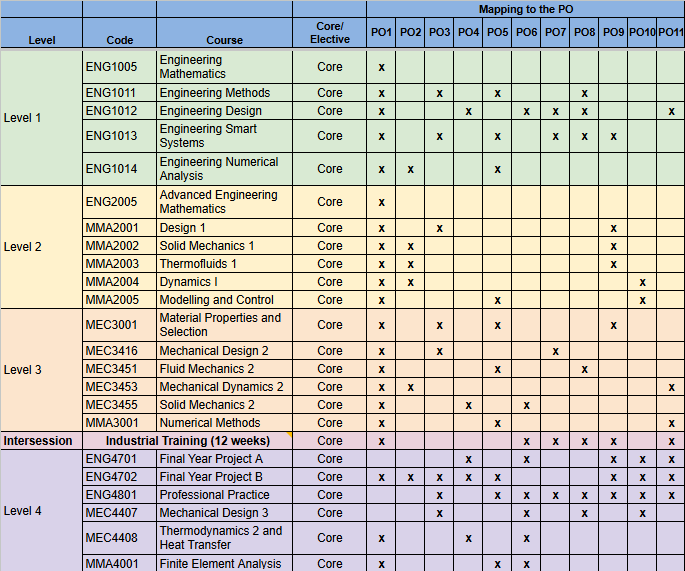
Mapping of Units to POs
Course
Student Activities