
New survey tracks changing Malaysian values
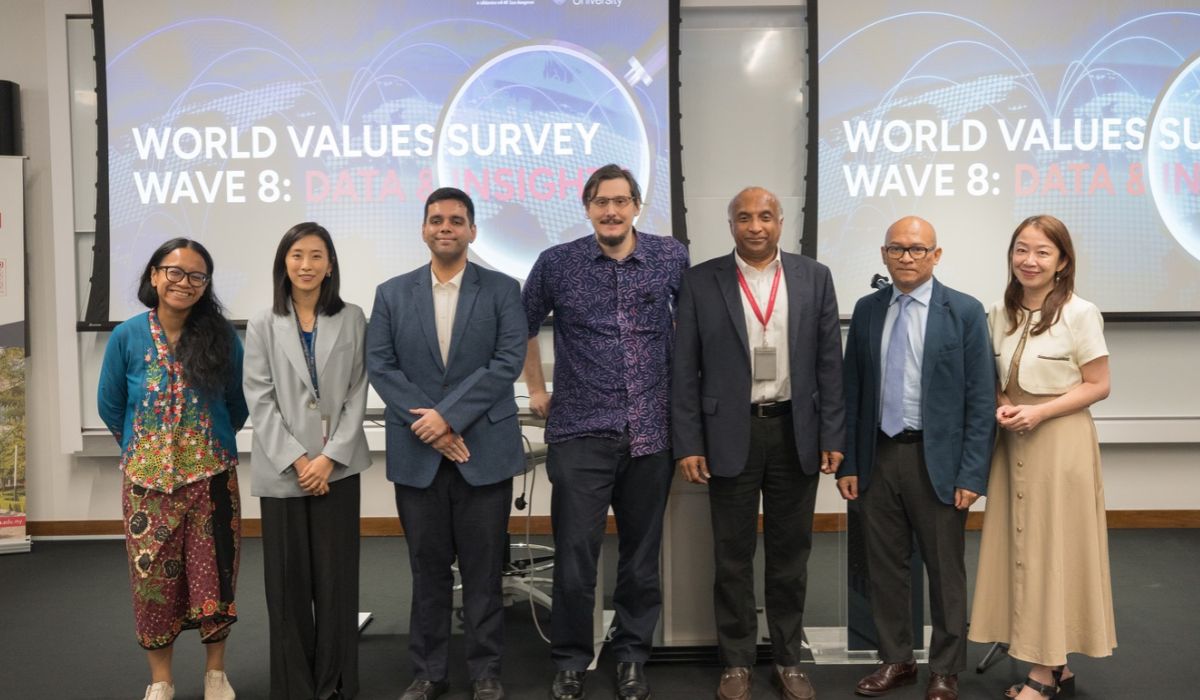 Professor Melati Nungsari (Associate Professor II of Economics, Deputy CEO and Deputy Dean of Research and Academics, Faculty Director of ASEAN Research Center (ARC), Professor Yi-Ren Wang (Associate Professor II of Organizational Behavior, Faculty Head of Mindset Lab@ASB, Associate Dean of Student Journey), Angad Singh (MBA alumnus (2025–2026) of the Asia School of Business (ASB), Professor Sam Flanders (Associate Professor II of Economics), Professor Joseph Cherian (CEO, President, Dean and Distinguished Professor), Professor Dato' Dr. Ir. Faisal Rafiq Mahamd Adikan (Vice President (Research & Development) Monash University Malaysia), Dr Grace Lee Hooi Yean (Professor of Economics and Head of the Department of Economics, Monash University Malaysia).
Monash University Malaysia and Asia School of Business (ASB) recently presented findings from the latest World Values Survey (WVS) Wave 8 at a launch event in Kuala Lumpur, revealing that two in three Malaysians (66 per cent) reported high satisfaction with their financial situation in 2025, up from 48 per cent in 2018.
The findings also show that overall life satisfaction among Malaysians reached its highest recorded level across all survey waves, with 79 per cent reporting high satisfaction with their lives in 2025. However, self-reported happiness has fluctuated across survey waves rather than showing a consistent upward trend.
The launch marked the first dedicated Malaysian release of WVS data, one of the world's largest and longest-running studies of human values.
The survey found that family and home life recorded the highest satisfaction level, with 81.3 per cent of respondents reporting high satisfaction. Among working Malaysians, 70.5 per cent reported high job satisfaction, while financial satisfaction stood at 66 per cent.
Beyond these measures, research presented at the launch also explored how Malaysians' values and perceptions of society shape their attitudes towards artificial intelligence (AI), fairness and social mobility.
Understanding different attitudes towards AI
Research by Associate Professor Sam Flanders, Associate Professor II of Economics at ASB, found that people across 11 different value groups showed broadly similar levels of support for AI. Optimism about technology was the only factor that consistently predicted support across these groups.
However, the reasons behind this support differed. Among faith-centred institutionalists, a group more common in countries such as Malaysia, people who favour a fairer distribution of wealth were more likely to support AI, potentially because they expected trusted institutions to use the technology to drive development and prosperity.
In contrast, among secular cosmopolitan liberals, more common in countries such as Canada, the same preference for wealth redistribution was associated with greater opposition to AI, driven by concerns about the influence of Big Tech and potential job losses.
“Malaysians and Canadians can arrive at similar levels of support for AI for almost opposite reasons,” said Flanders. “Here, many people see AI as a tool that trusted institutions will use to build prosperity. Elsewhere, the same desire for a fairer society makes people wary of who controls the technology. Anyone hoping to build public confidence in AI needs to understand which of those stories people are telling themselves.”
How perceptions of fairness shape beliefs about success
Another study by Associate Professor Dr Yi-Ren Wang of ASB and Angad Singh, Senior Software Engineer at Telenet Group and an ASB MBA graduate (Class of 2026), examined how perceptions of fairness and the enforcement of rules influence Malaysians' attitudes towards authority, success and social mobility.
The findings showed that Malaysians who perceived society's resources as unfairly distributed between the powerful and less powerful were 1.13 times less likely to respect authority than those who viewed resource distribution as merit-based. Conversely, those who believed rules were properly enforced and misbehaviour punished were 1.53 times more likely to respect authority.
The study also found differences in how these perceptions shaped beliefs about personal development and success. Those who had lower respect for authority tended to view success as dependent on powerful connections and intelligence as a fixed trait rather than something that could be developed. Paradoxically, they also viewed social mobility as more attainable.
Meanwhile, those who respected authority because they believed rules were properly enforced were more likely to believe that intelligence and skills could improve through effort, but were also more likely to view socioeconomic mobility as limited.
“How fair people believe the system is shapes far more than their trust in institutions – it shapes whether they believe effort pays off at all, creating paradoxical effects on personal development versus social mobility,” said Dr Wang, Associate Professor II of Organisational Behaviour at ASB.
“When resources seem tilted towards the powerful rather than earned on merit, people start to see success as a matter of who you know, and intelligence as something you are either born with or not. Where rules are enforced, people are more confident that skills can be built through hard work, even as deference to legitimate authority may inadvertently reinforce beliefs that social mobility is limited.”
Financial satisfaction and household realities
Commenting on the financial findings, Professor Grace Lee Hooi Yean, Head of the Department of Economics at Monash University Malaysia and an elected member of the WVS Association's Executive Committee, highlighted the increase in financial satisfaction between the two survey waves.
“The share of respondents who rated their household finances at least 7 out of 10 rose from 48 per cent in 2018 to 66 per cent in our latest survey,” she said.
However, the findings also revealed that in both surveys, about six in ten respondents said their families had just got by, drawn on savings or borrowed money over the previous year.
“For policymakers, a practical measure of progress is whether more families can put money aside for an unexpected bill,” she added.
The findings were presented to researchers, academics, policy analysts and members of the media at the launch in Kuala Lumpur, providing insights into how Malaysians' values, attitudes and perceptions have evolved across different areas of life.