
Monash University Malaysia, Nikon and Microlambda establish Malaysia’s first Nikon Centre of Excellence
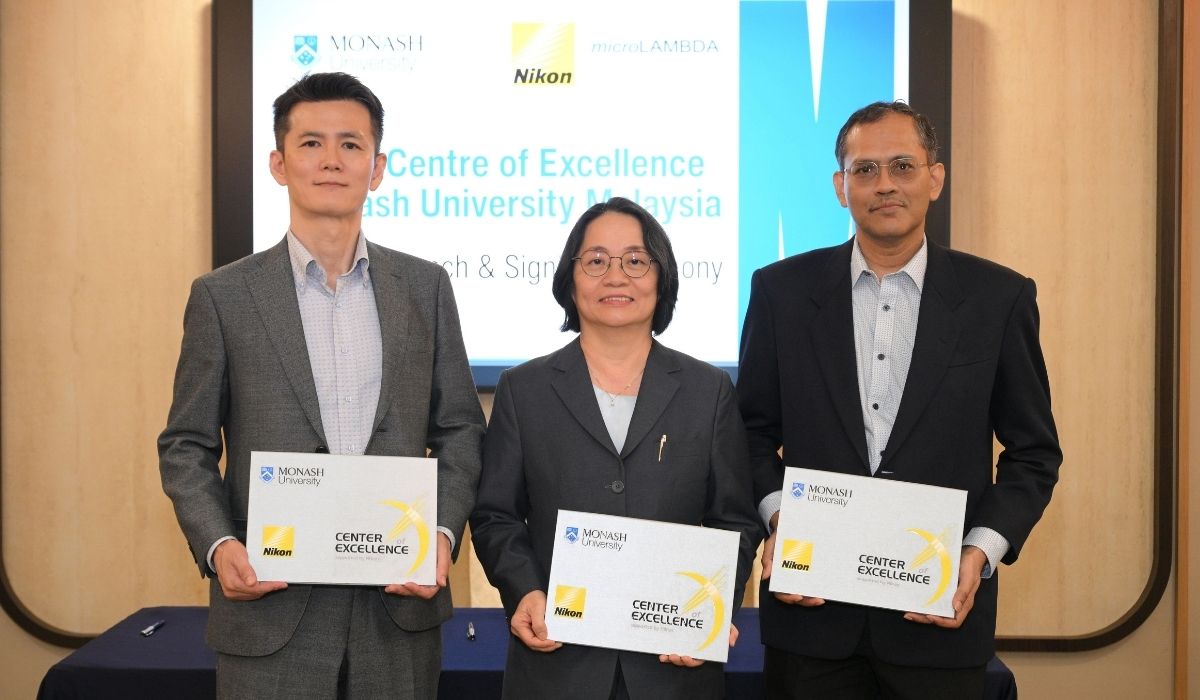 From left to right: Dr So Nishikawa, Yap Siaw Yan, and Professor Rakesh Naidu.
Monash University Malaysia has formalised a partnership with Nikon Singapore and Microlambda Sdn Bhd through a Memorandum of Understanding (MoU), marking the launch of Malaysia’s first Nikon Centre of Excellence on 6 October 2026.
The Nikon Centre of Excellence is a partnership between Nikon and the Monash University Malaysia Optical Imaging Platform (MUMOIP). Building on the platform’s existing imaging infrastructure, the centre strengthens its capabilities through access to advanced Nikon imaging technologies, technical support, application expertise and training. Open to researchers, students and institutional collaborators across Malaysia and beyond, the centre aims to widen access to specialist imaging facilities and strengthen connections between researchers, industry and the wider bioimaging community in Malaysia and Southeast Asia.
Under the agreement, researchers at the university will benefit from early access to Nikon’s latest technologies, including advanced demonstration systems and imaging and analysis software. The centre joins Nikon’s international network of partner institutions, following the establishment of a Nikon Centre of Excellence at Monash University’s Clayton campus in Australia in 2025.
The MoU was signed by Professor Rakesh Naidu, Deputy Head of School (Strategy, Innovation and Research) at the Jeffrey Cheah School of Medicine and Health Sciences (JCSMHS), Monash University Malaysia; Dr So Nishikawa, Senior General Manager, Healthcare Group, Nikon Singapore; and Yap Siaw Yan, General Manager of Microlambda Sdn. Bhd. Professor Rakesh signed on behalf of Brigadier General Professor Datuk Dr Mohd Arshil Moideen (Rtd), Head of JCSMHS.
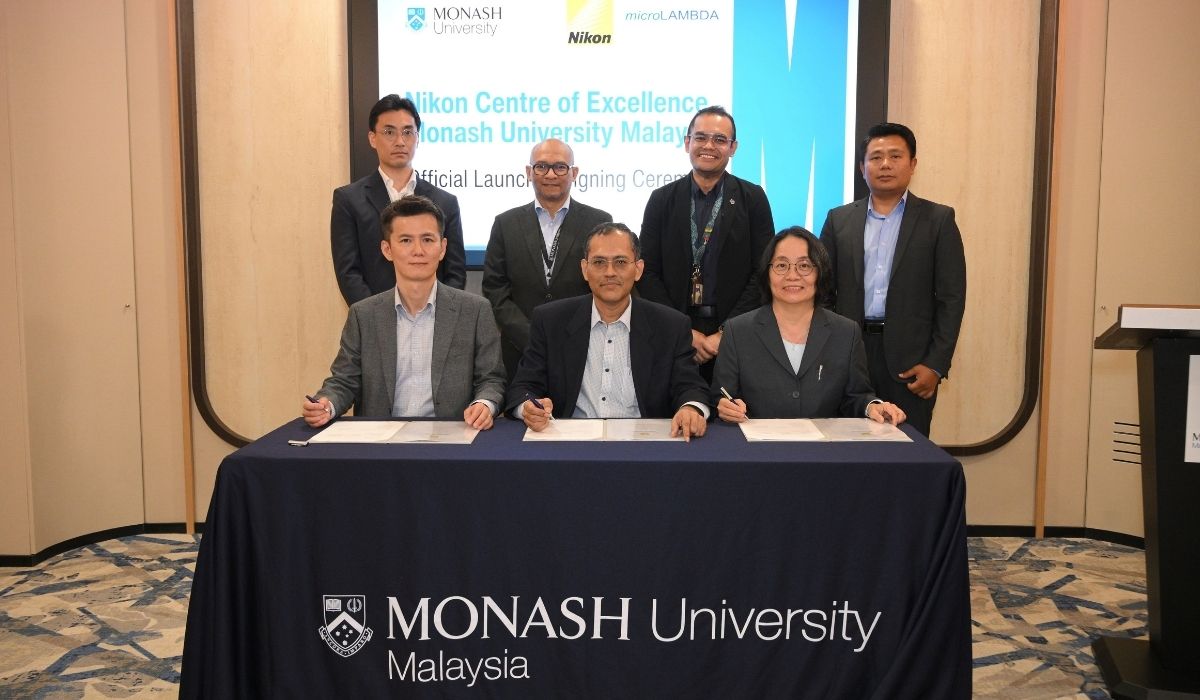 From top left to top right: Kazutaka Watanabe, Professor Dato’ Dr Ir Faisal Rafiq Mahamd Adikan, Dr Syafiq Asnawi, and Apandi bin Safuan. From bottom left to bottom right: Dr So Nishikawa, Professor Rakesh Naidu, and Yap Siaw Yan.
Speaking at the launch, Professor Dato’ Dr Ir Faisal Rafiq Mahamd Adikan, Vice President (Research and Development) of Monash University Malaysia, highlighted the university’s investment in research infrastructure, including RM10 million in capital expenditure funding across all its research platforms. “There is no doubt that we will continue investing. Receiving such acknowledgement will not only spur our researchers, but also allow us to form stronger collaborations with local, regional and international institutions,” he said.
Dr So Nishikawa, emphasised that technology must be supported by researchers’ expertise and effective collaboration. He described shared access to specialist equipment and knowledge as an important way to support growing scientific communities in Malaysia and Southeast Asia, with Microlambda providing local technical support. “Our main message today is our commitment to helping life sciences grow in Malaysia and supporting Southeast Asia,” said Nishikawa.
Apandi bin Safuan, Sales Manager at Microlambda Sdn. Bhd., described the centre as the next chapter in a relationship with Monash dating back to 2011, with support extending beyond the supply of equipment.
Dr Syafiq Asnawi, Senior Lecturer and Director of the High Impact Research and Education Transformation Department (HIRED) and the research platforms at JCSMHS, outlined efforts to integrate the school’s research infrastructure. He explained how the Optical Imaging Platform works alongside the Proteomics and Metabolomics Platform and the Animal Research Platform to support more integrated research workflows.
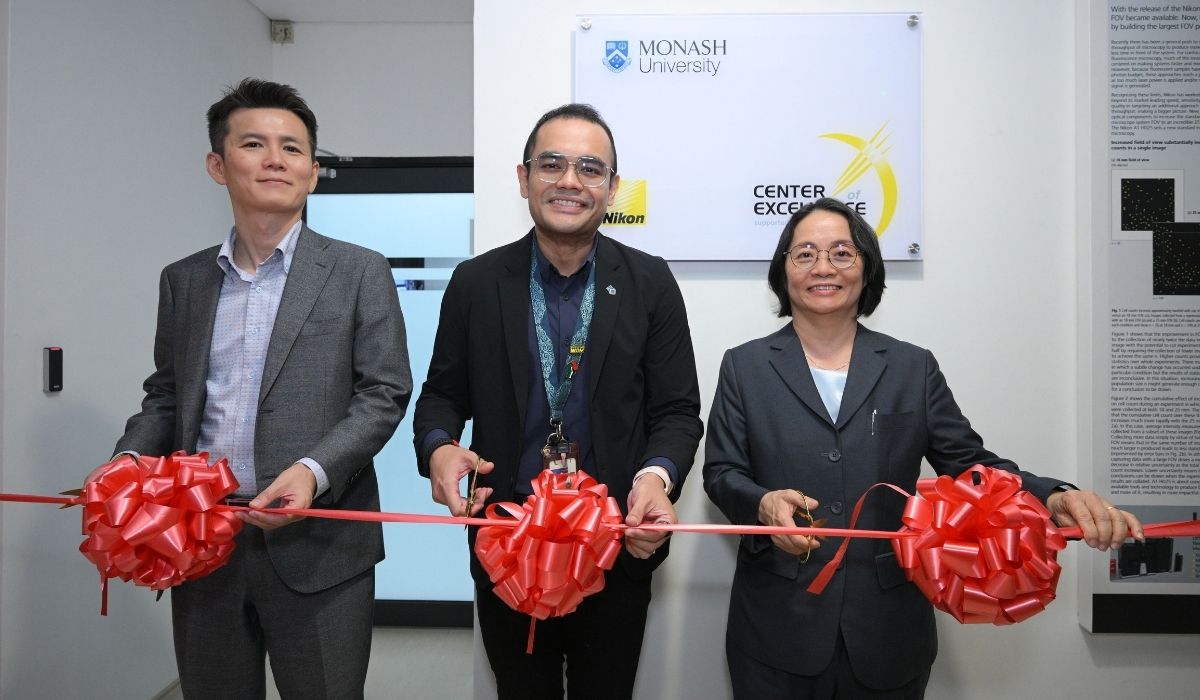 From left to right: Dr So Nishikawa, Dr Syafiq Asnawi, and Yap Siaw Yan during the ribbon-cutting ceremony.
The centre will support a broad range of life sciences applications. High-resolution fluorescence and confocal imaging will enable researchers to investigate the structure of cells and their internal components, as well as the location and interactions of molecules. Live-cell imaging will support time-lapse studies of cell movement, growth, viability and other dynamic behaviours under controlled imaging conditions. Its capabilities also extend to three-dimensional and quantitative imaging of tissues, organoids and other complex biological samples.
Access to the centre is managed locally through MUMOIP, with options including equipment access, technical training, imaging consultation and technical support.
The collaboration will support specialist training, knowledge sharing and the development of new imaging applications. By combining Monash University Malaysia’s academic expertise and research infrastructure with Nikon’s optical technologies and Microlambda’s technical support, the partnership aims to help researchers apply advanced imaging techniques to increasingly complex scientific questions.