
Agglomeration of industries in Malaysia

3 April 2022
In the coming decade, the country's shift towards higher value-added industries and the service economy is pertinent to ensuring continuous competitiveness and productivity growth. The success of the tiger cub economies of Southeast Asia, which includes Malaysia, Indonesia, the Philippines, Thailand, and Vietnam, has been contingent on substantial government intervention.
"The substantial government intervention has permitted Malaysia to chart a more rapid and balanced economic development than its neighbours. Conforming to Marshall's agglomeration theory, Malaysia's spatial policy allows different state governments (regional polities) to close the development gap and equalise job opportunities. The concentration of industries spurs local development through skilled labour, supplier linkages, and knowledge spillovers. Additionally, establishing economic regions (such as the Northern region, Southern region, East Coast region, East Malaysia) has helped bridge the growing imbalance among states in Malaysia. In order to identify the regional agglomeration of industries, location quotient (LQ) measurement is calculated using existing state-level employment data," said Dr Sharon Koh Geok May from the School of Business, Monash University Malaysia.
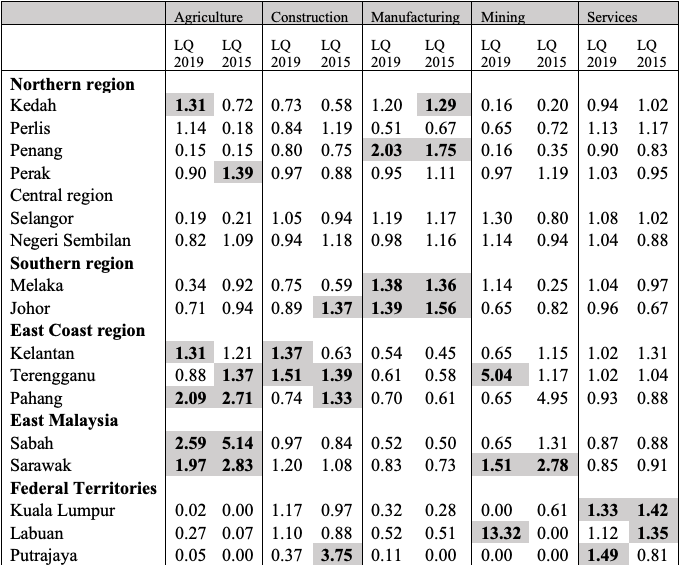
Table 1. Location quotients by state and region
Source: Author’s calculation based on open data from the Department of Statistics.
Note: In general, an LQ above 1.25 (shaded area in the graph) indicates that the area industry has the potential to be an exporter.
The clustering of activities is observed through employment in all the five key sectors (Table 1), with LQ ranging from 1.29-13.32.
"The Northern and Southern regions demonstrate manufacturing agglomeration, while the East coast region and East Malaysia show agriculture and mining. The Central region does not display any agglomeration given the equal distribution of employment. In the Northern region, agglomeration of manufacturing has increased in Penang. Penang continues to lead as the country's manufacturing hub, specifically in the electrical and electronics sub-sector. Meanwhile, in the Southern region, Melaka has plateaued, while Johor has declined," Dr Sharon explained.
According to her, although the East coast region and East Malaysia continue to lead in agriculture, there is a gradual shift towards other sectors. The construction sector has shown a significant increase in the East coast region (e.g., Kelantan and Pahang), but a substantial decline in the Federal territory - Putrajaya. In general, construction has increased in almost every state. Mining continues to thrive in locations endowed with natural resources, specifically oil and gas. Meanwhile, the federal territories continue to lead in services.
COVID-19 impact on agglomeration
The movement restrictions and lockdowns during the COVID-19 pandemic had severely disrupted the service industry and affected the manufacturing and construction sectors due to the dependency on foreign labour.
"Preliminary analysis indicates reliance on the country's primary and secondary industries such as agriculture, mining, and manufacturing. As the manufacturing sector becomes less cost-efficient due to competition from China and other Southeast Asian countries such as Vietnam, the country is at risk of "hollowing out". The question remains whether Malaysia will gradually shift towards a service-based economy as part of its growth trajectory. Despite the clustering of economic activities and regional specialisation, government policies can shift the sectorial share of economic activities," Dr Sharon shared.
From a policy perspective, findings highlight the role of government policies to foster knowledge spillover and enhance the country's competitive advantage.