
Strengthening B40 women entrepreneurs through Pasar Pintu
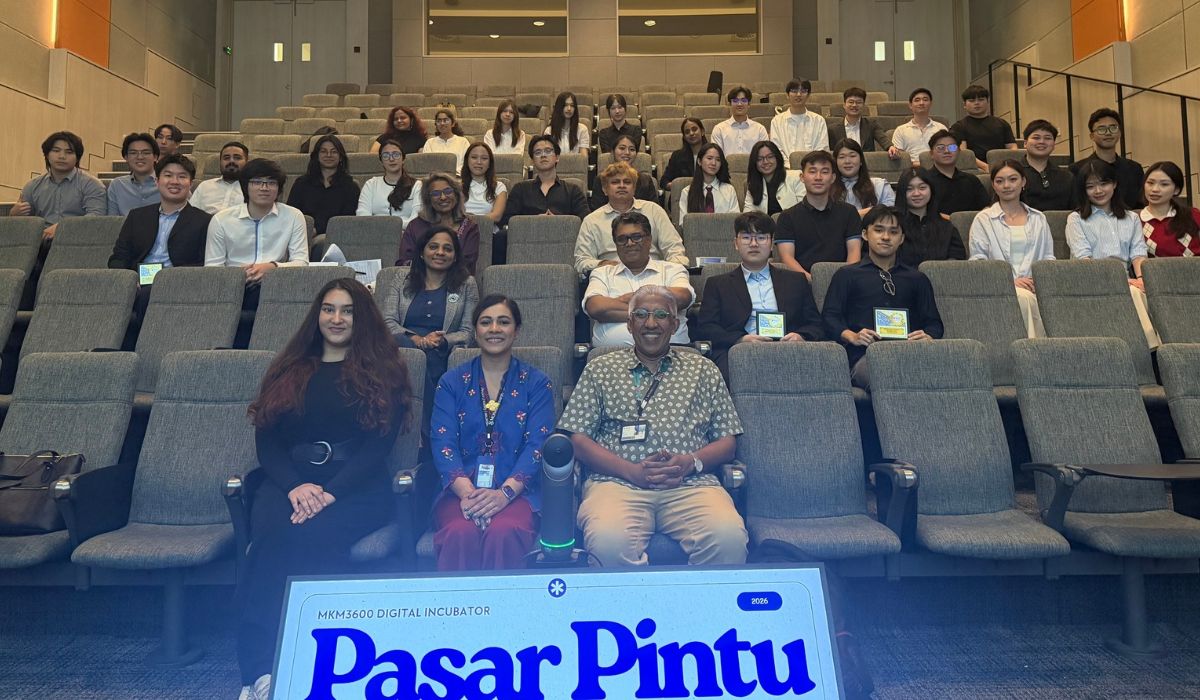 Group photo of Monash University Malaysia students, industry judges and attendees at the Pasar Pintu final pitch.
A community initiative supporting women from Malaysia's urban B40 communities to build small businesses is entering a new phase, with Monash University Malaysia working to help them turn waste into opportunities through circular economy practices.
The project, titled Pasar Pintu Circular Transformation: Advancing Sustainable Livelihoods, Nutrition, and Community Enterprise in Urban B40 Communities, is funded by the Ministry of Higher Education (MOHE) under the Dana Inovasi Sosial (DIS) 2026 grant. Led by a team from the School of Business in collaboration with social enterprise partner Primus Wellness Sdn Bhd, the initiative aims to strengthen the sustainability and resilience of Kedai Pasar Pintu, community-based enterprises operated by B40 women.
Pasar Pintu, meaning "market at your doorstep", was established to empower women from urban B40 communities through nutrition education and micro-entrepreneurship. The initiative has already trained nearly 100 women and supported the establishment of three Kedai Pasar Pintu (micro enterprises).
Building on this foundation, this project seeks to help these micro-enterprises move beyond conventional retail practices by introducing circular economy principles that reduce food waste, improve resource efficiency and create additional income opportunities.
Under the initiative, the project team will work with the three Kedai Pasar Pintu to enhance their business practices with circular economy principles. These measures are intended to help women entrepreneurs manage perishable produce more effectively, minimise losses from unsold stock and improve business profitability.
The project will also explore ways to turn suitable surplus fruits and vegetables into value-added products, creating potential new revenue streams from produce that might otherwise go to waste.
Other areas of development include sustainable packaging, product labelling, digital marketing, alternative sales channels, inventory/stock-taking practices etc. The team also plans to explore pre-order arrangements and collective branding under the Pasar Pintu identity to better connect the businesses with customers.
Beyond the community-based interventions project, the school is collaborating with Primus Wellness to create opportunities for students to contribute their knowledge and skills towards addressing practical challenges faced by entrepreneurs.
As part of this effort, final-year digital marketing students from our School of Business worked on a live industry brief through the MKM3600 Digital Incubator unit, developing ideas and solutions to support Pasar Pintu's community enterprise model.
The students presented their proposals during the Pasar Pintu final pitch, applying their digital marketing learning to a real-world business context. The presentations were evaluated by industry representatives, including the Chief Executive Officer and Chief Operating Officer of Primus Wellness Sdn Bhd, which manages the Pasar Pintu initiative, alongside an external industry consultant.
Following the presentations, selected student reports will be reviewed by Primus Wellness and Monash University Malaysia to identify ideas with potential for further development and implementation.
This activity reflects the School of Business's approach to experiential learning, where students engage with industry and community partners to develop solutions beyond the classroom.
For the women involved, this means more than reducing food waste. Better inventory management and resource utilisation could help reduce operating losses, while product diversification and improved market access could create additional income opportunities.
The longer-term ambition is to develop a practical and scalable circular social enterprise model that could be adapted for other urban B40 communities in Malaysia, demonstrating how small community businesses can contribute to more inclusive and sustainable economic development.