
Students invent plastic debris capturing device
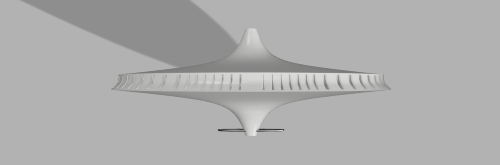
Parabolic floater
Plastics have become a convenience that we cannot live with. From life-saving devices to everyday appliances, they have revolutionised the way we use them - making them impossible to live without. The throw-away plastic culture has become omnipresent, prompting worldwide efforts to deal with the eight million tons of plastic waste that escapes into the oceans every year. Plastic pollution is and will continue to be a problem if the world is unable to deal with irresponsible and unethical methods of dumping them.
Understanding that every single person has to play a part in protecting the planet, year-one students from the School of Engineering, Monash University Malaysia, designed a parabolic floater to collect floating plastic debris on the surface of oceans and rivers. Koo Theen Wai, Darren Lim Yuan Khai, Chong Zhen Wei, and Senithi Sesanya Lorensuhewa, led by Izaac Chong Yen Juin, were inspired by Dutch inventor and entrepreneur Boyan Slat's invention and buildings designed to withstand tornadoes.
The parabolic floater acts as a floating container, setting it apart from traditional litter traps installed at riverbeds, which utilises a floater to capture floating debris. Because of its ability to float, the invention pushes the ocean currents to sail around, forming a separate velocity to the current of the ocean or river, facilitating the trapping of plastic debris. The device is able to collect waste as it goes because it uses hydrofoils that can be pushed forward and across the water. It is also equipped with fringes that allows it to travel slower than the ocean and trash.
"Our invention is different from Bayan's Ocean Cleanup. It doesn't contain a floating barrier. We designed a protruding curved wall as an integral part of the system, which serves as a container to trap plastic debris. Our system is dependent on the ocean current and uses wind forces to press the system down to stabilise it - enabling it to survive in storms," said the team members.
Team leader Izaac Chong shared that the project began during Week Four of Semester One, 2021. He stated that working in a virtual environment was challenging, especially since a team member was situated in Sri Lanka and adjusting to the timezone difference was something they had to work on.
"We started our work by defining the goal and scope, then formulated a work breakdown structure which helped facilitate our meeting. Since the project spanned from week four to 12, we decided to have a regular follow-up meeting to work on it. Our supervisor, Dr Issac Lim Sing Sheng recommended that we participate in the James Dyson Award 2021," Izaac Chong elaborated.
"Ten years ago, there was a video about how scientists filmed tornadoes from within the twisters themselves. They placed a camera inside a sharp conical object to minimise the suction force of the tornado acting on the filming camera, therefore completing the filming. We decided to incorporate that design into the parabolic cleaner to avoid it being crushed and toppled by winds and waves," he added.
The students kickstarted this project under ENG2801 Leadership and Innovation, offered under Common Engineering for first-year engineering students. "In this project, the students demonstrated the ability to benchmark for solutions in domains that are beyond the existing plastic debris solutions. They proceeded to circumnavigate and innovate alternative solutions using the variety of tools under the TRIZ design methodology. Further modelling and prototyping will be carried out to validate and improve the parabolic floater's effectiveness in capturing plastic debris," stated Dr Issac Lim.
Cleaning up plastic waste in the oceans and rivers is incredibly costly. With this in mind, the team designed the Ocean Parabolic Cleaner using significantly less expensive materials hoping that the design could be scaled to a much larger size to suit the demands of plastic debris retention.
"We hope that with this design, we could deploy this low-cost device, which contributes to SDG14: Life Under Water, by protecting marine life from the harm of plastic debris," said the students.