
Engineering hope for better mental wellness
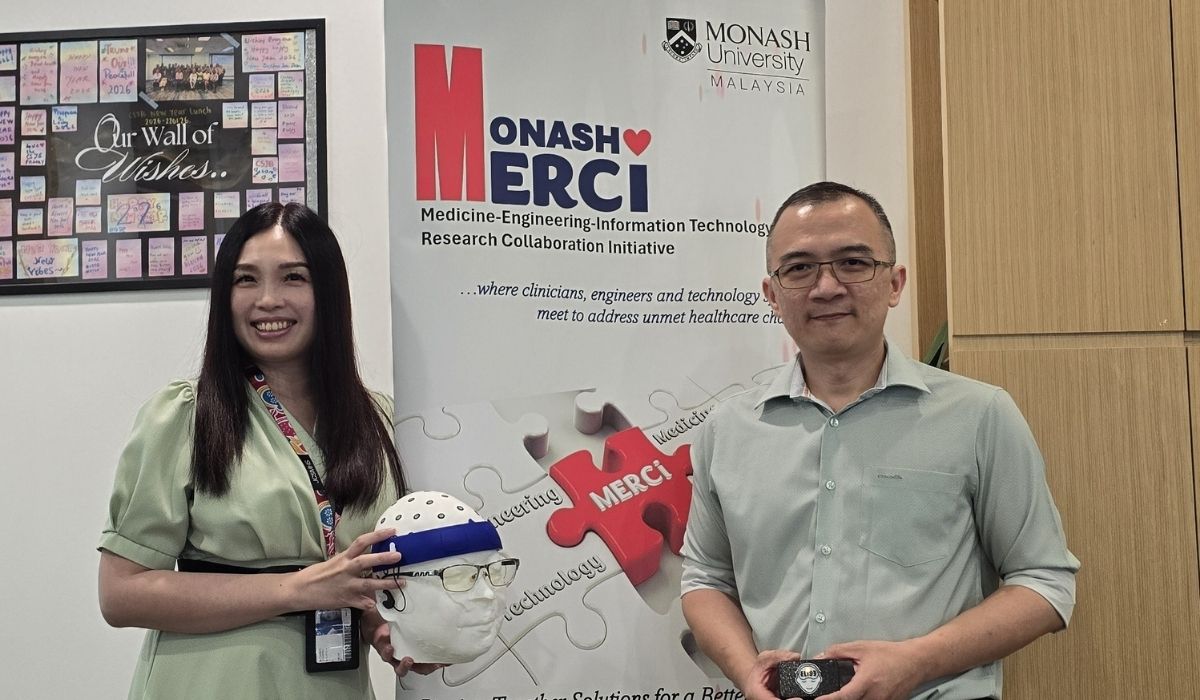 Associate Professor Ooi Ean Hin (Right) presenting version 8 of ELiSE to Associate Professor Dr Anne Yee (Left) during MERCi 5.0 at the Clinical School Johor Bahru.
When Associate Professor Dr Anne Yee from the Jeffrey Cheah School of Medicine and Health Sciences first approached Associate Professor Ooi Ean Hin in November 2024 with a challenge, the question was simple but ambitious. Could a low-cost transcranial direct current stimulation (tDCS) device be developed for clinical and home use?
That question would eventually lead to the development of ELiSE, short for Electrically Induced Synaptic Enhancement, a tDCS-based neuromodulation device currently being developed by researchers and students at the university. The project is part of Monash MERCi, a joint initiative by the School of Engineering, School of Information Technology and clinicians from the Clinical School Johor Bahru, which connects engineering solutions with real-world clinical challenges.
Transcranial direct current stimulation, or tDCS, is a non-invasive neuromodulation method that uses low-intensity electric current to stimulate targeted areas of the brain. It has been studied for a range of applications, including mental wellness, cognitive performance, mental fatigue, and mental health conditions such as depression and anxiety.
“Access to mental health solutions remains a major challenge in Malaysia and Southeast Asia, driven largely by high costs and the persistent stigma associated with seeking mental health treatment,” said Associate Professor Ooi. He also said that this project aims to address these barriers through the development of an affordable, home-based tDCS device that improves the accessibility of neuromodulation therapy for the general population.
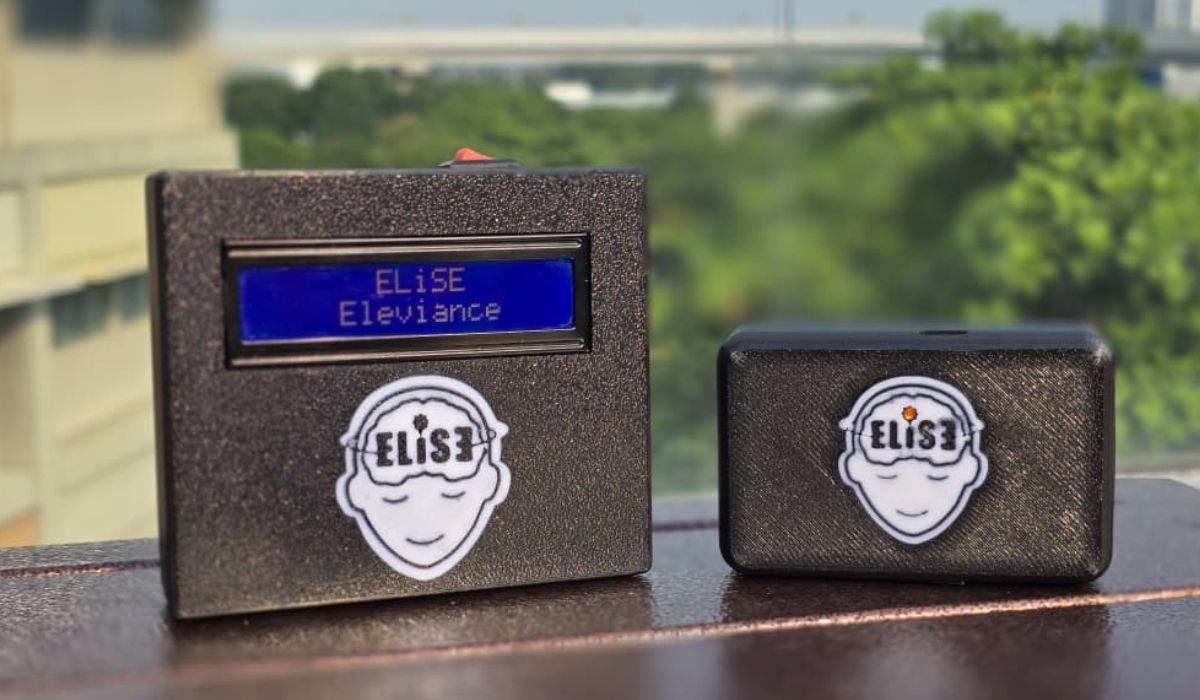 ELiSE versions 7.5 (right) and 8 (left), alongside a mock-up of the headset currently undergoing development. Version 7.5 is a standalone prototype with a single-button control, while version 8 has Bluetooth functionality, allowing it to be paired with the homegrown mobile app.
The development of ELiSE began with a simple proof-of-concept circuit on a breadboard. From there, the team worked through several design iterations. By version 6, the system had evolved from an early circuit into a working prototype.
Further refinements led to version 7, which introduced a more compact form by moving away from module-based units. Its fully 3D-printed casing allowed users to set basic stimulation protocols, including current intensity and stimulation duration. Following feedback from Associate Professor Dr Anne, the team developed version 7.5 with a flatter, more device-like design for performance testing.
The current prototype, version 8, now includes Bluetooth connectivity and can be paired with an in-house-developed mobile application, allowing users to monitor and control therapy sessions on their smartphones.
The device and accompanying mobile application were developed by undergraduate students Chia Pei Juin and Ng Qiao Yan under the supervision of Associate Professor Ooi and Associate Professor Dr Anne.
Pei Juin, a Mechatronics Engineering student and research assistant in the Biomedical Engineering Modelling and Simulation group, has been responsible for the design and development of the prototypes from version 1 to version 8. Qiao Yan, an Electrical Engineering student and research assistant in the same group, has contributed to the development of the mobile application that will support future versions of the device.
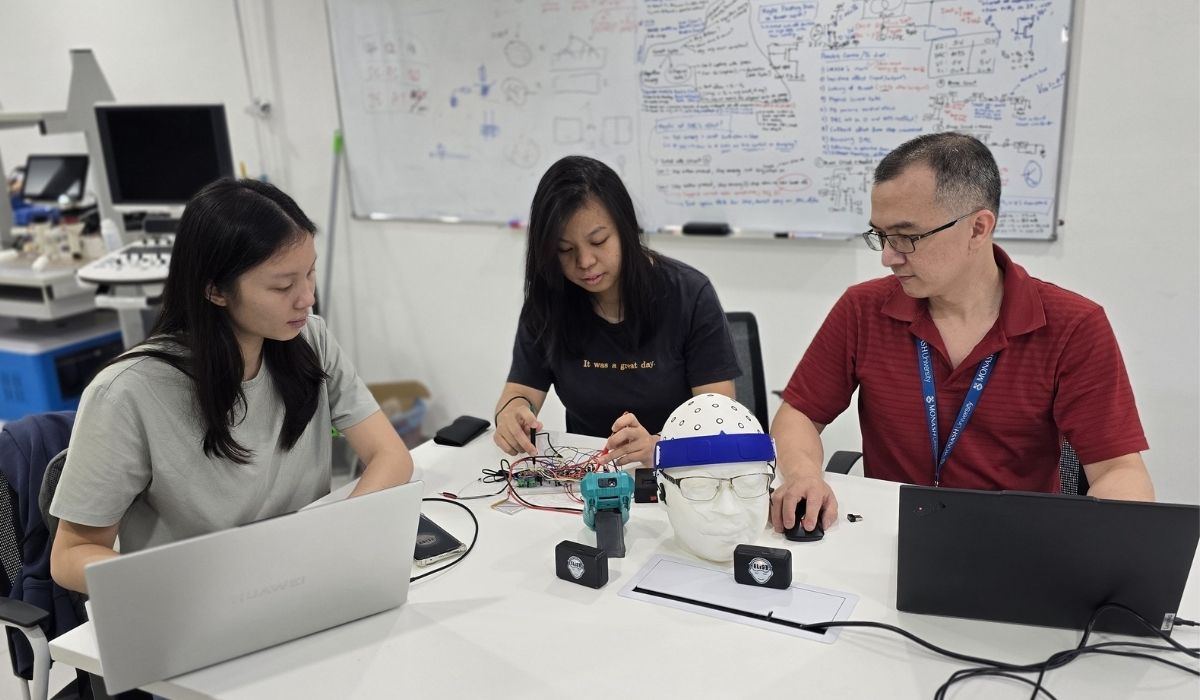 From left to right: Ng Qiao Yan, Chia Pei Juin and Dr Ooi Ean Hin working on ELiSE in the Biocentrics Laboratory
To support the development process, the team also created a 3D-printed head model from a volunteer's scan. Nicknamed “Eugene”, the model allows the team to better visualise electrode placement and plan device development before progressing to human studies.
The team has also received ethics approval to study the side effects induced by the tDCS device. This will not be a clinical trial on its effectiveness as a mental health treatment, but will focus on quantifying dermal side effects when stimulation is applied to the skin over the forearm.
While tDCS is often associated with the management of mental health conditions, the ELiSE team is also exploring its potential in supporting cognitive performance, focus, mental wellness and cognitive resilience. One potential area of application is supporting healthcare professionals who work under intense workloads and demanding schedules.
Moving forward, the researchers hope to collaborate with healthcare institutions and relevant partners interested in adopting tDCS as part of broader mental wellness and fatigue management initiatives. The team has also launched a dedicated ELiSE website and LinkedIn page to share updates and invite collaboration.
Everyone involved is working towards a shared goal, making safe and affordable neurotechnology available to support mental wellness and performance.