
Monash University Malaysia and STREAM Industries advance industrial emissions research
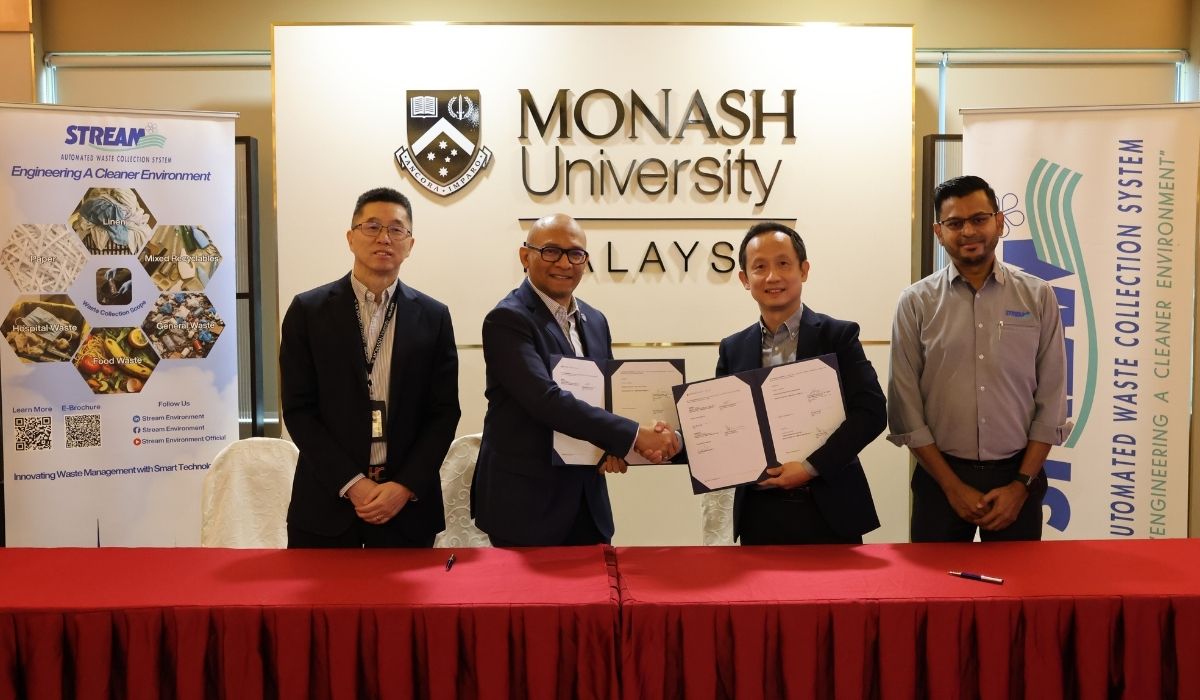 From left to right: Professor Anthony Guo, Professor Dato’ Dr Ir Faisal Rafiq Mahamd Adikan, Ir Chea Thean Teik, and Magesh Kumar Suppu during the signing ceremony.
Monash University Malaysia and STREAM Industries Sdn Bhd signed a Memorandum of Understanding (MoU) and a Research Collaboration Agreement for industrial research, education, and professional development.
The partnership will create opportunities for joint research initiatives, access to industry data and infrastructure, professional development activities, staff and student engagement, and the pursuit of research funding. The organisations may also jointly deliver seminars, workshops, training activities and other programs that support knowledge exchange between academia and industry.
Professor Anthony Guo, Head of the School of Engineering, signed the MoU on behalf of Monash University Malaysia, while Ir Chea Thean Teik, Chief Executive Officer of STREAM Industries, signed on behalf of the company.
A separate Research Collaboration Agreement was signed by Professor Dato’ Dr Ir Faisal Rafiq Mahamd Adikan, Vice-President (Research and Development) at Monash University Malaysia, and Ir Chea. The agreements were also acknowledged by Dr Lau Ee Von, the project’s principal investigator, and Magesh Kumar Suppu, Chief Technical Officer of STREAM Industries.
Taking effect on 1 September 2026, the MoU will provide a framework for collaboration between the School of Engineering and STREAM Industries across industrial research and final-year projects.
The first research initiative under the partnership is a three-year project titled “Development of Nanocomposite Hydrogels for VOC and Odour Control in STREAM Waste Emissions”. Supported by RM125,000 in funding from STREAM Industries, the project will be led by Dr Lau and conducted from September 2026 to August 2029.
Volatile organic compounds (VOCs) and odours released through industrial waste emissions can affect air quality, occupational safety and human health. These emissions may contain a mixture of polar and non-polar VOCs, making them difficult to manage using conventional adsorption technologies designed to capture only a limited range of compounds.
STREAM Industries will contribute technical guidance, access to its waste-emission streams, materials and industry facilities, while the university will provide the research expertise needed to develop and assess the proposed technology.
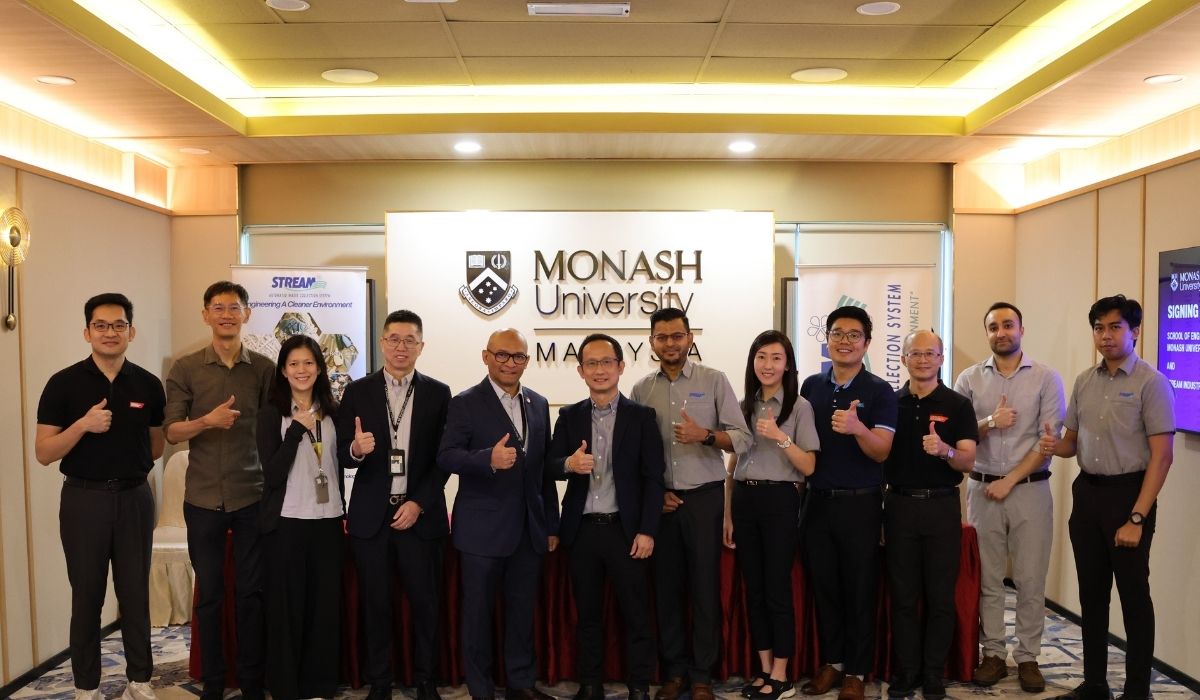 Group photo of representatives from the university together with representatives from STREAM Industries.
“I am very thankful for the strong support from STREAM Industries and the trust they have placed in our research team. The signing of the MOU and Research Grant Agreement marks an important milestone in our collaboration with STREAM Industries. We hope this partnership will enable us to expand our research and develop innovative solutions for sustainable waste management. With our research, we aim to help turn STREAM’s vision of pioneering automated solid waste disposal into reality and transform the way solid waste is collected, handled and disposed of,” said Dr Lau Ee Von.
Following the signing ceremony, Ir Chea delivered a technical talk, after which participants visited one of STREAM Industries’ automated waste collection systems (AWCS) installed at ViiA Residences Kuala Lumpur. Both activities were organised by the Institution of Mechanical Engineers Monash Student Chapter, giving students direct industry exposure and an opportunity to see how the technology is applied within a residential setting.
The activities built on the School of Engineering’s existing engagement with STREAM Industries, which has included previous technical talks by Ir Chea and an earlier student visit to an AWCS at Kuala Lumpur International Airport.
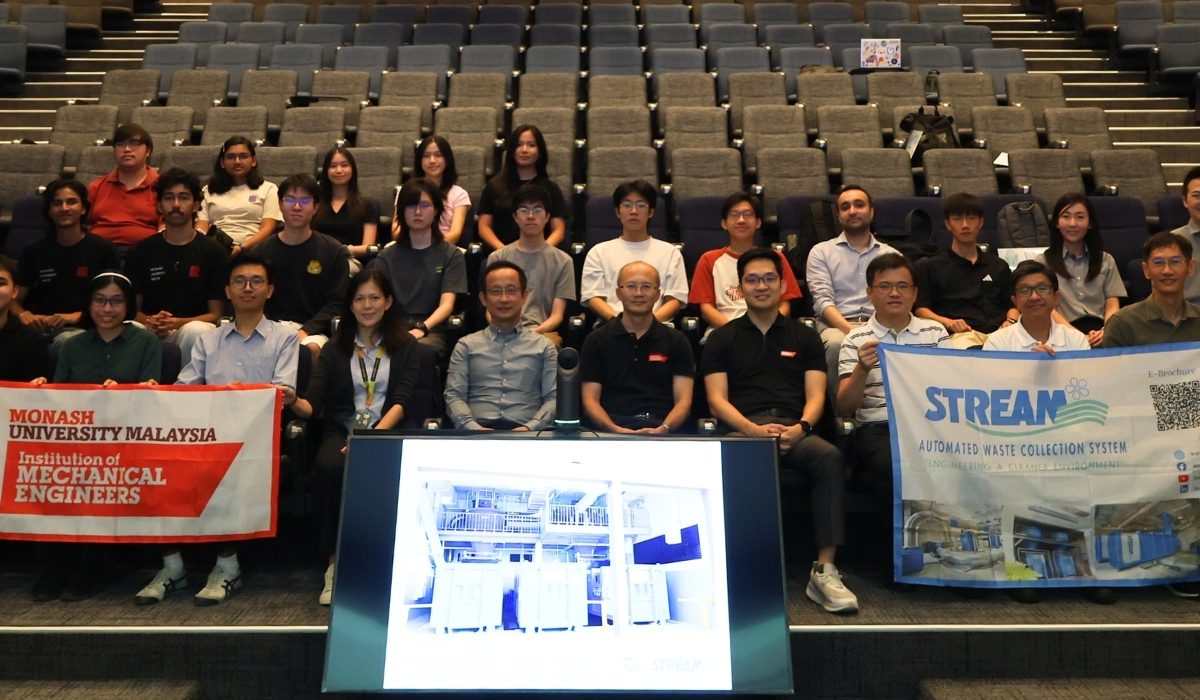 The technical talk delivered by Ir Chea.
Through the partnership, the aim is to translate university research into practical industrial applications while providing students and researchers with opportunities to work on real-world engineering challenges.