
Nuclear Magnetic Resonance
NMR spectroscopy is a very powerful and one of the most informative non-destructive analytical techniques. We provide services on NMR analysis, consultancy and training for internal and external customers. The full range of solution NMR experiments are offered, including routine 1- and 2D proton, carbon-13 and multinuclear experiments. Advice on experiment selection and data interpretation is also available. Together with routine NMR experiments, we offer our help in identifying unknown materials, determining chemical structures and product properties, quantifying components in a mixture, and analysing conformational and molecular dynamics.
Expertise
- Advanced NMR expertise and state-of-the-art support for industrial, government and academic research.
- Identification of unknown materials, determination of chemical structures and properties of small molecules, polymers or natural products.
Key Instrumentation
- High resolution NMR Avance NEO 300 spectrometer (Bruker)
Equipment
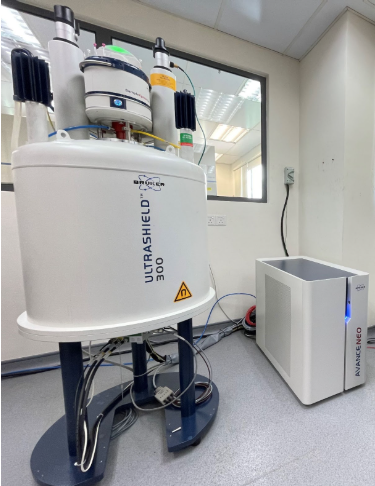 |
Sample Preparation
Samples can be prepared by the operator. In this case, cost of sample preparation and solvent are borne by the customer. Deuterated solvents are charged at cost price or may be supplied by the customer.
If you are preparing samples by yourself, make sure that you use NMR tube of the following dimensions: 5 mm - diameter, 7-8’’ – length. Quality of the results will be greater in you obey the following simple rules in the preparation of your sample:
- Check that the NMR tube and cap are clean and dry.
- Do not heat tubes or store them in an oven as it is likely to distort the tube.
- Use roughly 5-10 mg for 1H, 20-50 mg for 13C experiments depending on the nature of your product. Using higher concentrations may reduce time for the data collection, but it may increase viscosity of solutions leading to poor resolution.
- Make up the sample in a small tube or test tube in the appropriate amount of solvent and transfer into the NMR tube – use ~0.7ml of solvent.
- Sample length in the NMR tube should be ~5 cm long using 0.7 ml of solvent. Shorter samples will produce spectra with much poorer resolution.
- Solid particles, especially those in cloudy solution drastically reduce spectral quality. Do not use large quantities of solvent to dissolve samples, use the minimum volume and filter (either use tissue wrapped round the end of a Pasteur pipette, or filter through a Pasteur pipette plugged with a piece of tissue).
Do NOT use NMR tubes or caps with any sign of damage. The operator will reject samples for analysis if they are submitted in damaged tubes / caps or in case of any evidence of sample leakage.
Arrange with the operator prior to preparation of sample solutions if the sample is unstable.
Specialist Services
The full range of solution NMR experiments are offered at the operating frequency of 300 MHz, including routine 1- and 2D proton, carbon-13 and multinuclear experiments. Advice on experiment selection and data interpretation is also available.
Specialist service #1: NMR analysis
Outsource your facility’s NMR analysis and focus on strategic projects; we guarantee rapid turnaround for your routine NMR sample analysis.
Typical analysis includes:
- Preparation of the sample using our tubes and solvents. Sample extraction, if requested
- Data acquisition, processing and plotting of the spectrum with integrals, peak lists and expanded plots as needed
- Spectral interpretation, if requested
- Creation of a .pdf document containing spectral plots
- Multiplet analysis with coupling constant calculation
- Providing raw data files, if requested
- Return or disposal of the sample as requested
Specialist service #2: Training for internal and external customers
Download NMR Facility eFlyer here.
Request for services on NMR Facility iLab
Publications and Acknowledgements
Your use of the Monash Malaysia Research Infrastructure is heavily subsidised by the University. To comply with internal reporting obligations, the platform must report on the number and type of publications produced by users of the platform/ facility. It is essential that we have this information so that we can continue to provide the advanced instrumentation, staff, training and assistance that you and other researchers require to undertake your work.
It is a condition of use of facility that:
1. You acknowledge the platform and any significant assistance provided by the staff members in your publications;
2. Platform staff members who made a significant scholarly contribution should be co-authors on the publication, in accordance with Monash’s Research Authorship And Attribution Policy, see Research Authorship and Attribution Policy.
Please acknowledge MUMNMRF in your publications by including:
"The authors acknowledge the use of instruments and scientific and technical assistance at the Monash Malaysia Nuclear Magnetic Resonance Facility (MUMNMRF)”.
Or,
if the work was carried out with help from MUMNMRF staff (but not enough to justify coauthorship):
"The authors acknowledge the use of instruments and scientific and technical assistance of Name of NMRF Staff Member at the Monash Malaysia Nuclear Magnetic Resonance Facility (MUMNMRF).”
Please always notify the relevant facility when acknowledgment is made.
Location
Building 4, Level 6
School of Pharmacy,
Monash University Malaysia