
Building a sustainable future
According to statistics by the World Bank Group, climate change is expected to displace over 216 million people by 2050 due to rising sea levels and extreme weather events. With the world combatting these urgent challenges, the need for sustainable solutions has been more critical. In response, the 2024 Sustainable Development for Thriving Communities Conference held at Monash University in Indonesia brought together leading researchers and policymakers for an inspiring exchange of ideas and networking session.
The conference started off with a warm welcome by Asad Islam, Director of the Centre for Development Economics and Sustainability (CDES), followed by an opening address from the President and Pro Vice-Chancellor of Monash University Indonesia, Professor Matthew Nicholson. The conference organised by CDES at Monash Business School, in partnership with Monash University in Indonesia and Malaysia, the World Bank’s East Asia and Pacific Chief Economist Research Center (EAPCE), and the Asian Development Bank Institute (ADBI) addressed critical issues surrounding sustainable development and climate change.
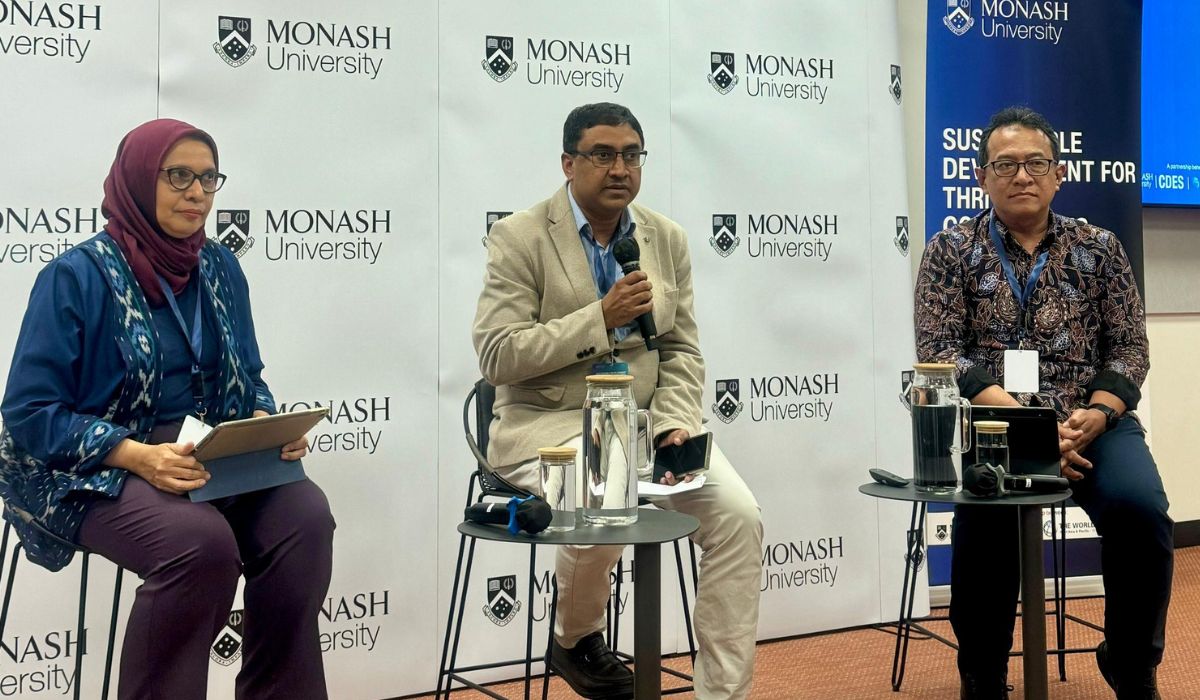 From left: Dr Vivi Alatas, Professor Asad Islam and Dr Elan Satriawan.
Participants were able to present research on diverse topics such as climate change adaptation and resilience, renewable energy transitions, sustainable agriculture, food security, green transportation, and inclusive economic development. These areas emphasised the conference's commitment to fostering comprehensive dialogue on sustainability and innovative strategies to tackle climate challenges.
Professor Yasuyuki Sawada, from the Faculty of Economics, University of Tokyo focused on the three generations of empirical research in economics, particularly highlighting the third generation's bottom-up approach, which emphasised stronger relationships with stakeholders and the crucial role of big data and science. He then drew attention to the importance of collaboration between researchers, policymakers, and stakeholders to utilise innovative data sources and advanced data science techniques for more precise and practical economic research.
This is in line with Monash University’s strategic 2030 plan, which prioritises stakeholder engagement, evidence-based policymaking, and the application of big data and data science to drive innovation and sustainable development. Through these combined initiatives, Monash aims to take forward the global challenges and strengthen its impact by developing more informed and adaptable policies.
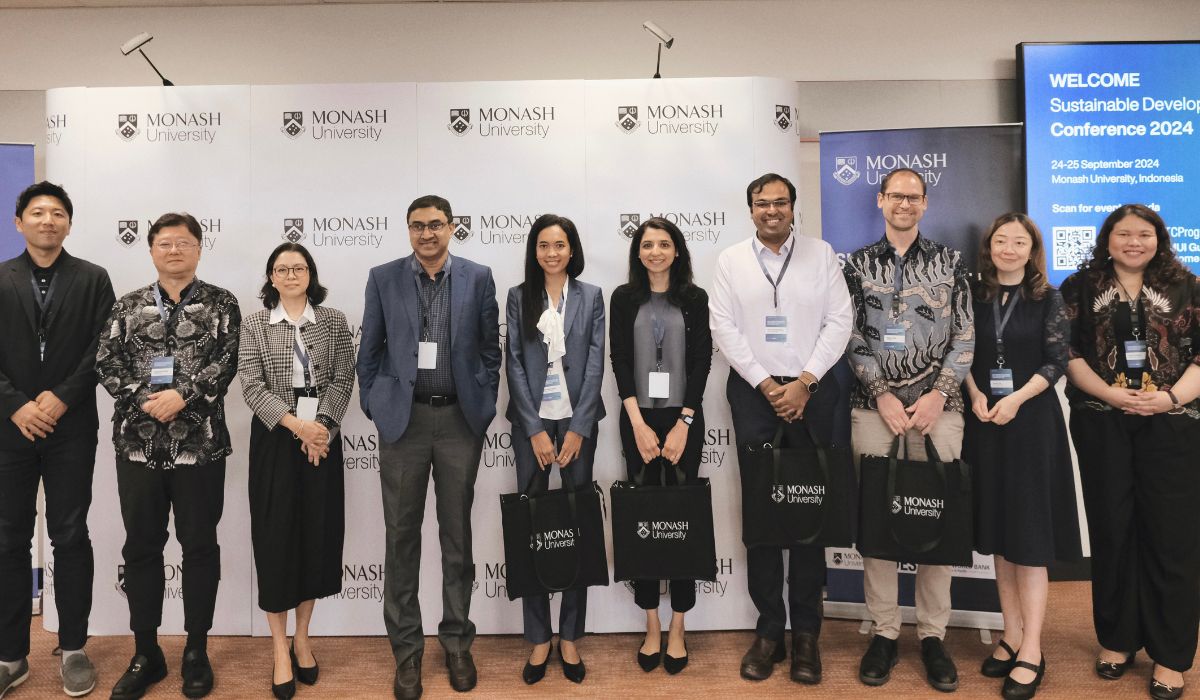 From left: Assistant Professor David Park, Professor Yasuyuki Sawada, Professor Majah-Leah V. Ravago, Professor Asad Islam, Assistant Professor Naila Shofia, Assistant Professor Yogita Shamdasani, Assistant Professor Saravana Ravindran, Dr William Seitz, Professor Grace Lee and Dr Sarah Gultom.
Other speakers at the conference included Assistant Professor Yogita Shamdasani and Professor Saravana Ravindran from the National University of Singapore. Professor Yogita focused on the impact of climate change on human capital in India, while Professor Saravana examined the effects of climate change-induced salinisation on worker productivity. Associate Professor Majah-Leah V. Ravago, President and CEO of the Development Academy of the Philippines, addressed disruptions in energy grids due to power price fluctuations. Rounding out the discussions, Assistant Professor David Park from the Korea Development Institute School of Public Policy analysed the dynamic effects of cash transfers on agricultural households.
The conference was followed by a policy session on Social Protection and Poverty Alleviation, which highlighted the vital role of research in reducing poverty in Indonesia. Dr Elan Satriawan, Chief of Policy at TNP2K, and Dr Vivi Alatas, Senior Advisor from the National Team for the Acceleration of Poverty Reduction (TNP2K), discussed how evidence-based approaches like Randomised Controlled Trials (RCTs) drive policy reforms and improve programs. Indonesia’s impressive poverty reduction, from nearly 40% in the 1970s to single digits by 2018 underscores the impact of these strategies. TNP2K continues to work with researchers to develop programs that address the complexities of poverty and protect vulnerable groups during economic crises.
The 2024 Sustainable Development for Thriving Communities Conference was a lively gathering of diverse thinkers and passionate changemakers committed to addressing pressing global issues. Participants engaged in meaningful discussions, sharing innovative ideas and insights that influenced collaboration and inspiration. It is noteworthy that SDTC was launched in Kuala Lumpur in December 2023, and this is the second SDTC. Plans are in place to return to Kuala Lumpur in 2025, alternating between Malaysia and Indonesia to foster ongoing dialogue and cooperation in sustainable development.
As the conference progressed, it became evident that the discussions and networks formed a groundwork for future initiatives in sustainable development. Each session strengthened the importance of interdisciplinary collaboration and the ability of shared knowledge in driving impactful change. By bringing together a community of dedicated individuals, the conference not only addressed critical challenges but also a renewed commitment to building resilient, thriving communities.