
Air pollution from fossil fuels linked to over 22,500 premature deaths and an economic loss of 5% of Malaysia’s GDP, Lancet Countdown report finds
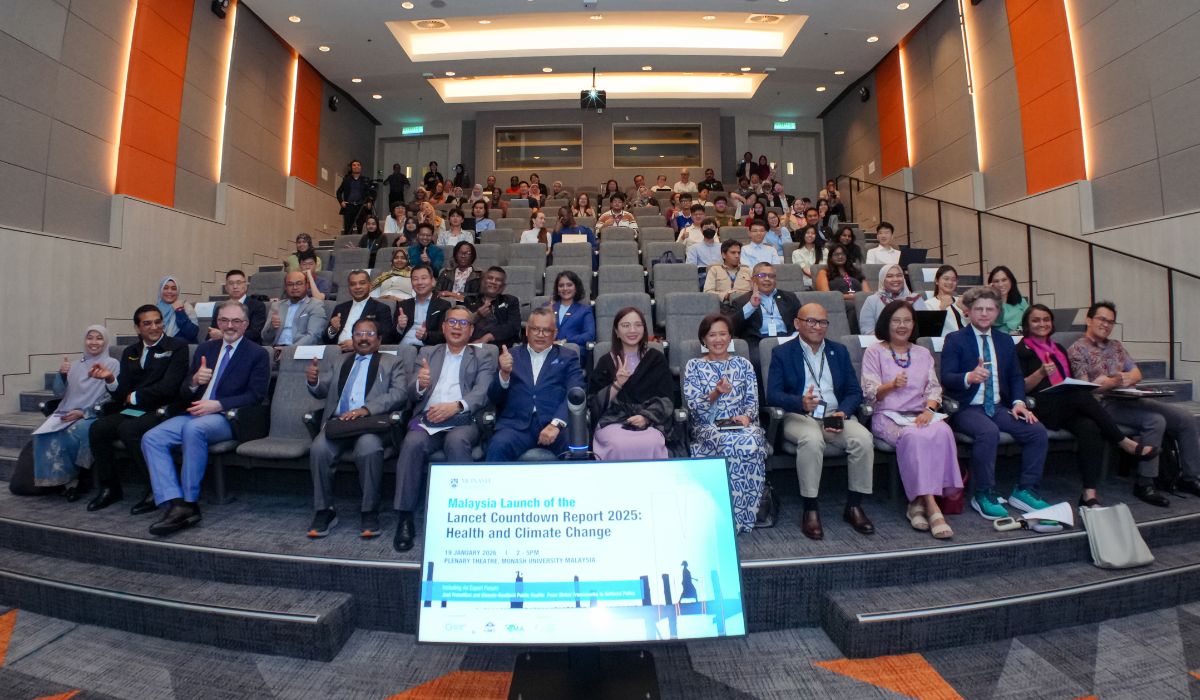 Front from left to right: Dr Thahiratul Asma Zakaria (Deputy Director (Non-Communicable Disease), Disease Control Division, Ministry of Health, Malaysia), Dr Sivanaesan Letchumanan (President-Elect of the Malaysian Medical Association (MMA)), Professor Dr Maziar Moradi-Lakeh (Co-Author of the 2025 Lancet Countdown Policy Document for Malaysia), Professor Dr J.A. Jayalal (President, Commonwealth Medical Association), Professor Ts Dr Mohd Zamri Ibrahim (Vice-Chancellor, Universiti Malaysia Terengganu (UMT)), Professor Dr Mohamad Salmi bin Mohd Sohod (Chairman of the Universiti Malaysia Terengganu (UMT) Board of Directors), Yang Berhormat Puan Jamaliah Jamaluddin (Member of the Selangor State Executive Council for Public Health, Environmental Sustainability, Climate Resilience and Green Technology), Professor Emeritus Dato' Dr Adeeba Kamarulzaman (President & Pro Vice-Chancellor, Monash University Malaysia), Professor Dato’ Dr Ir Faisal Rafiq Mahamd Adikan (Vice President of Research and Development, Monash University Malaysia), Prof Dr Tin Tin Su (Director, The Regional Hub for Asia Climate Change and Health (REACH), Monash University Malaysia), Professor Dr Meisam Tabatabaei (Lead Collaborator, Lancet Countdown; Universiti Malaysia Terengganu (UMT)), Dr Revati Phalkey (Director, United Nations University, International Institute for Global Health (UNU-IIGH)), Daniel Lee (Executive Director, Selangor Climate Adaptation Centre), as well as the attendees of the event.
Climate change is no longer a future risk for Malaysia. It is already driving preventable deaths, economic losses and growing pressure on the health system, according to the Lancet Countdown 2025 Report on Health and Climate Change, launched in Malaysia today.
The report shows that in 2022 alone, more than 22,500 deaths in Malaysia were attributable to anthropogenic air pollution, with 61% linked to fossil fuel use. The economic cost of these premature deaths reached US$21 billion, equivalent to 5% of Malaysia’s gross domestic product, underscoring the direct link between climate inaction, public health harm and economic loss.
Globally, the health impacts of climate change are accelerating. Heat-related deaths now average 546,000 each year, while 84% of heatwave days experienced between 2020 and 2024 would not have occurred without climate change. Rising temperatures and extreme weather have also pushed 123.7 million additional people into moderate to severe food insecurity, and air pollution from fossil fuels and household energy caused an estimated 4.8 million deaths worldwide in 2022.
Officiating the launch, Yang Berhormat Puan Jamaliah Jamaluddin, Selangor’s Executive Councillor for Public Health, Environmental Sustainability, Climate Resilience and Green Technology, emphasised that climate change is already posing direct and measurable risks to health, livelihoods and development in Malaysia. “The Lancet Countdown 2025 Report reveals that the health impacts of climate change are worsening, and delay in action is costing lives and livelihoods around the world. These are not distant projections; they are real, measurable harms that are happening now. These trends reinforce what Malaysians have lived through and witnessed, that climate change is not abstract, but is now a health concern and threatens food security, water access and labour productivity.”
Monash University Malaysia, through the Regional Hub for Asia Climate Change and Health (REACH), hosted the official Malaysian launch of the Lancet Countdown 2025 Report on Health and Climate Change. Held in collaboration with Universiti Malaysia Terengganu, the Commonwealth Medical Association and the Selangor Climate Adaptation Centre, the event created a national platform to connect the latest global scientific evidence with Malaysia’s policy and public health priorities.
The report’s findings were highlighted by Dr Marina Romanello, Executive Director of the Lancet Countdown, and Professor Dr Meisam Tabatabaei, Lead Collaborator, who spoke about how climate-linked hazards like extreme heat, air pollution and shifting disease patterns are affecting health outcomes and resilience strategies.
The report highlights that in 2024, a record 640 billion potential work hours were lost globally due to heat exposure, with low and middle-income countries most affected. Rising temperatures are also reshaping disease patterns, with the climate-driven transmission potential of dengue increasing by 48.5% for Aedes albopictus and 11.6% for Aedes aegypti since the mid-20th century.
Drawing on Malaysia-specific analysis, the forum identified three national priority risks where climate change is already amplifying health and economic pressures: Just Transition, Food Security and Dengue Resilience. Malaysia is experiencing rising heat exposure, shifting infectious disease patterns, and persistent air pollution, with impacts felt most acutely by outdoor workers, urban communities, low-income households, and vulnerable populations including older people, women and children.
Malaysia’s energy profile further compounds these risks. Between 2016 and 2022, CO₂ emissions from fossil fuel combustion increased by 11%, exceeding 240,000 kilotonnes. As of 2022, coal accounted for 47% of electricity generation, while renewable energy contributed less than 1% of total energy supply, highlighting the health stakes of delayed energy transition.
“A just transition will only be meaningful if it reduces health risks for vulnerable people,” said Professor Dr Tin Tin Su, Director of REACH Hub for Asia. “Through REACH, we are working to apply global and regional climate-health evidence into locally relevant data and solutions so that our findings can inform Malaysia’s policies to protect those who are most exposed, not just those who are easiest to reach. Equity-centred climate and health co-benefit would be a way forward.”
 From left to right: Professor Dr Mohamad Salmi bin Mohd Sohod (Chairman of the Universiti, Malaysia Terengganu (UMT) Board of Directors), Yang Berhormat Puan Jamaliah Jamaluddin (Member of the Selangor State Executive Council for Public Health, Environmental Sustainability, Climate Resilience and Green Technology), and Professor Emeritus Dato' Dr Adeeba Kamarulzaman (President and Pro Vice-Chancellor of Monash University Malaysia).
While Malaysia has developed multiple climate and public health strategies, including its National Policy on Climate Change, National Health Policy and health adaptation planning, speakers at the forum stressed that the greatest challenge is not policy ambition, but delivery across sectors. Economic, energy, environmental and health systems still operate in silos, leaving gaps in how climate risks are managed on the ground.
The Lancet Countdown 2025 Report concludes that climate change inaction is already costing lives and livelihoods, but that climate action offers a lifeline, delivering immediate health, economic and equity gains if acted upon decisively.